

How to Survive in a Country that’s Killing You
Alifya Maheswari
I studied English literature in university. My father said I had been determined to do so since I was in elementary school; mentioned the major and the university by name. He, too, had studied the exact same thing in the same exact university some decades ago. When people learned this, they thought I wanted to walk in my father’s path. I was always quick to correct this. It wasn’t that I wanted to follow my father, though I did—do—look up to him to some extent, but because I was in love with words, with stories, with literature.
It was a love my father accidentally grew in me when he came home from work one night bringing a box full of secondhand books from the thrift market. I was about 7 years old. He said some of those books were for me. I took one, mesmerized. Leafing over the pages of a children’s novel, I quickly fell in love with the beauty of narratives.
The love stayed with me. I devoured so many books as a child, then a teenager, when I was supposed to be outside playing with friends. I frequented many libraries and even became friendly with the librarian at my high school.
It didn’t stop with consuming words; I also wanted to string together my own. I wrote my first short story when I was 9, about a clay mug that had to endure a painstaking but valuable burning process to make it useful and beautiful to look at. I showed it to my homeroom teacher, who put it up on the wall magazine in front of our classroom. I remember feeling so proud because someone else saw value in what I created.
I wrote more. I joined the club for student journalists in middle school and wrote for the school magazine. I volunteered to write articles for an education nonprofit after I graduated high school. Words are my sandbox. I can roll around in it, build castles with it, and feel proud of my ability to shape whatever I desire.
Having read many literary fiction, poetry, and plays, including those written by Oscar Wilde, James Baldwin, Intan Paramaditha, Arundhati Roy, Toni Morrison, Maggie Nelson, Mary Shelley, and Kate Chopin, I am enthralled by beautiful prose. I appreciate being taken on a ride by long flowing sentences, bittersweet dialogues, and ornate figures of speech. I love similes, and metaphors, and allegories. I love things that stand for something else. So much so that I observe it becoming a crutch in my own writing sometimes.
They’re beautiful; metaphors. I have learned to dress hurt and anger and fear in something else; using some other words. They can also, I realized lately, be a coping mechanism. Staying in a dysfunctional relationship can be described as being trapped in a tornado. Having a loving yet painful relationship with my mother can be described as facing a cracked mirror.
This method of describing something as something else is effective. It’s a way of distancing myself from it. It helps me endure. It makes me think that, maybe, if I say it prettily enough, the beauty will distract me from the bleeding wound.
I also learned, however, that this is not always the best way to deal with hurt. Or anger. Or fear.
It is not easy to live in a country so blatantly repressive to so many diverse and marginalized identities. Living in Indonesia—religious, conservative, heteronormative, patriarchal, capitalist-driven Indonesia—as a neurodivergent, queer, and working-class woman might be closely described as living in hell. Over the years I have built a defense mechanism to cope with this; a mechanism that has proven to work for me: dress the hurt in something else. I have written essays. I have written poems. I have built my own community to act as a fortress to keep queer people like me safe amongst ourselves.
Some time ago, I might have written about it in the form of a fairytale.
Once upon a time in Indonesia, a former president was also a brilliant puppeteer. He pulled strings, conspired to torpedo the constitution, and ensured a smooth road to power for his son.
Once upon a time in Indonesia, the next president was a giant that was elected despite the blood on his hands. He continued to use his thumb to squash the little people trying to rise up against him.
Once upon a time in Indonesia, people couldn’t get employed, couldn’t own homes, couldn’t buy food. They were chained in their little desks, fishing for coins under the threat of poverty, while outside, people were shot in the streets and kids were poisoned from government-sanctioned meals promised to bring prosperity.
But today I cannot afford to do that anymore. Today I am deciding to abandon the metaphor for straightforward honesty. And that straightforward honesty is this: I live in a country that is killing me.
— —
In the past two years, I have been more and more similar to a dragon. I have been hoarding. But unlike a dragon, it is not treasure that I hoard; it is evidence. A collection of horrifying and well-documented facts that point to the conclusion I made earlier. Take a look at the trove with me:
More than 5 thousand cases of food poisoning have befallen Indonesian students after they consumed the free lunch provided by the government—the same “free” lunch program which was prioritized above budgeting for education, gender-based violence, and disaster relief.
A woman was detained and criminalized for posting a story on Instagram mentioning her frustration about police brutality. She was made as an example for the whole country to never speak up against the ruling class.
A human rights defender—who stopped the sneaky government meeting in a luxurious hotel room when the whole country was forced into economic efficiency—was attacked with acid on the road, at night, by those claimed as national military personnels. He is now blind in one eye, and his case was not even brought to civil court. The case was merely discussed in military court, in which the military judge regretted that the action was not executed neatly, instead of condemning the morality of the act itself.
The national currency, rupiah, has fallen at a terrifying rate. When this essay was written, 1 US dollar was worth 18.171 rupiah, breaking the national record for the lowest exchange rate in history. The president, however, did not seem fazed by this, and instead dodged the obvious problem by saying, in his speech, that Indonesian people in rural areas don’t use US dollar as a currency, therefore it is not a problem.
A wave of demonstrations erupted around Jakarta in August–September 2025, voicing out frustrations around economic struggles, which includes the lack of promised job opportunities and the government’s wasteful spending. The demonstrations then spread nationwide after the murder of Affan Kurniawan, a gig driver, by police officers in one of the protests. What followed was a mass arrest of more than 6 thousand protesters in an attempt to silence democracy.
There are so many more I cannot expand on, lest we would be here all day.
When times are politically rough, it is only predictable that the entire nation looks around for a punching bag. In 1997–1998, when political unrest erupted due to the monetary crisis and the New Order government’s authoritarianism, it was the people of Chinese descent that Indonesians hunted down as a scape goat.
Other times, it is the queer community. It doesn’t always necessarily follow political unrest, but when political unrest does happen, the government needs to blow up a miniscule issue to distract the people. The Indonesian people, on the other hand, need to let some steam off from being constantly brutalized by the ruling class. As a result, they are often a bit too excited about finding more vulnerable targets to brutalize so they can feel powerful—displacement, as Freud theorized. I don’t usually like to cite Freud for anything, but perhaps he was onto something for this one.
In 2016, Support Group and Resource Center on Sexuality Studies Universitas Indonesia (SGRC UI), a study club formed by university students to learn about SOGIESC, was under fire. They were accused of being a gay organization presenting a threat to the morality of higher educational institutions. The university offered no protection whatsoever, claiming that the club was never affiliated with the university to begin with. Public officials made statements saying that gay people have no place on campus. This triggered a wave of state-backed homophobia in Indonesia, with effects lasting up until now.
In June 2025, the police raided a gathering of 75 gay men in Bogor and detained many of them. The gathering was cruelly framed as an immoral gay sex party, when in truth it was a gathering for a private talent show in a villa.
In May 2026, two bad news emerged: a university in Padang, West Sumatra, expelled a student as punishment after his room was unjustly raided for proof of homosexuality. At the same time, the district council of Lima Puluh Kota, West Sumatra, finalized the drafting of a local regulation forbidding LGBT in the regency, with threats of administrative fine and forced rehabilitation for lawbreakers.
Two days into June 2026, queer people in Indonesia—particularly Jakarta—were hit by a fresh tragedy. Two young men, one of them a university student, were recorded without consent while kissing on a campus. When other students in the area discovered it, the two of them were physically paraded around, made to receive physical violence, and put in an unlawful student tribunal in a circus of humiliation for the public.
Matters were made even worse by livestreaming done by a few students. The news spread fast on social media. The two young men were shamed and bullied both on the internet and in real life. The father of one of the men came to the student tribunal, proclaiming that he was deeply ashamed of his son, and bowed down to the audience to apologize for his son’s action.
The university, after having done absolutely nothing to stop the mass violence or protect the dignity and wellbeing of these two young men, is now conducting a disciplinary trial to decide the fate of the student. Many local queer organizations have published statements protesting this unjust treatment and homophobic discrimination. Many of them have also tried to reach the victims in an attempt to provide them with legal and psychological help, but to no avail.
The case would be the first out of many attacks on queer rights in the country this year. By the time this essay was edited, plenty more had occurred.
There was rampant online harassment directed at various student press organizations, as well as other queer and feminist communities, who published posts about Pride Month and queer rights.
The local government of Bandung, West Java, has passed a regional regulation stating queer people as sexual deviants.
The Indonesian Ulema Council (Majelis Ulama Indonesia; shortened into MUI), the largest Islamic scholars body in the country, has proposed a bill to criminalize LGBT people.
Most fatally, mob attacks have spread across the country. They formed communities to hunt down queer people and uploaded cruel videos on their Instagram account, flaunting a series of attacks in different cities, which includes chasing, kicking, dragging, spraying urine, throwing stones, and electrocuting. The victims are often the most vulnerable people in the community: transwomen, especially those working in the streets, either for busking or sex work.
These attacks on human rights can be strongly credited to the presidential regulation on national defense policy signed by Prabowo Subianto in October 2025. The regulation names “the promotion of LGBT culture” as a nonmilitary threat, along with acts of terrorism, radicalism, and separatism.
This level of state-sanctioned homophobia is the worst ever seen in Indonesia since 2016, and it has only gone on for two months. Activist groups and civil society alike have had to act quickly. Protests were organized. Consolidations and meetings were held. Tears have been shed; blood has been spilled. Everywhere I look, it is despair that’s reflected on everybody’s face. Or anger, or sadness. Mostly, it is fear.
Once again, the walls seem to be closing in on us. Only this time, they may be closer than ever.
— —
It is complicated living in a country so hateful of anything even remotely opposed to those in power. I remember going on a digital safety training for young human rights defenders with some nine other activists. Our instructor was telling us a feature in a safety app could self-destruct in 5 seconds after we activate a sliding button, for emergency situations.
I turned to the girl sitting next to me and I found her already grinning. We joked, “This is for when we’re near death and want to make sure no evil party can take control of our data,” and ended it with a genuinely excited, “This is so cool!”
This is what my country had rendered us to: A bunch of young people in our 20s being excited about data safety and movement continuity beyond death.
Another time, I remember seeing a post on Instagram about tips to survive by swimming upward when you have been tied and thrown into a body of water. I remember watching it in interest, saving it, and thinking, “Neat. Now I know I can survive situations like that if I’m ever endangered because of what I do.”
In retrospect, I can admit how humorously delusional it is, to think that I could just… calmly absorb this knowledge and effectively put it into use later. As if panic wouldn’t override the entire control panel if we’re actually drowning. As if all knowledge wouldn’t fly out of the window. As if “hacks” would have saved me.
— —
I am a feminist activist and a queer community organizer in a country that is actively killing me and people like me. I often wonder how one survives in that kind of environment. I live my life answering that question every day. Now, after three years of digital feminist activism and two years of on-the-ground queer activism, I can finally put together a guide.
So, how do you survive in a country that’s bent on killing you?
You write a reference letter for your friend who is applying for a grant to create a standard operating procedure for queer safety. She goes on to get the grant and asks you to help with organizing the programs. You say yes.
You send money to a friend who is trying to survive, make sure she can eat lunch that day.
You watch a friend initiate a sports club for fellow queer people and see updates of their Instagram stories where they pose together in a badminton court or in a swimming pool or in front of a pool table, sweaty and tired and happy.
You become the president of the local chapter of an international feminist organization network and show that young queer people can be leaders. You make sure there is room, a safe one, for people like you to be themselves. Small, young, afraid. You will make sure they are less afraid by the end of your term.
You kiss the girl you are in love with. You acknowledge the important role she occupies in documenting the movement and believe her when she tells you that you are brilliant. You do not let go of her hand, even when passersby leer and throw insults. The two of you are gentle with each other every time. You make plans to survive alongside her for a long time, because happiness must also be fought for.
You take care of your elders. You listen to their stories, remind them that they’re doing great and their fight is appreciated, and you take their advice. You ask if they have eaten and hug them whenever you meet.
You go to coalition meetings, closed meetings, strategy meetings, community meetings. You contribute to the discussion in the room and to the living documents. You listen to people’s heavy sighs and squeeze their hands. A promise.
You celebrate your queer community’s second anniversary—a sign of stubborn hope, lotus in the damn muddy water. You grow, you bloom, to hell with everything else.
You take care of each other, because you are all you’ve got. In all kinds of ways. You ask for help and let yourself receive it, because community is only community if everyone shoulders the work together.
Some days it’s enough. Some nights you will lie awake at night tortured by the gnawing feeling in your stomach that it’s not enough, it will never be enough. But you must ignore it, you must. It is imperative that you squander that voice from the pitch black of terror, because existing, and trying, and waking up to fight another day, are all different ways of sending the exact same message: a middle finger to a country that’s trying to kill you, and a sinister smile saying, “I am still here.”
— —
I remember walking back together with my friends after successfully organizing an intergenerational discussion of 60 queer activists from three different generations.
It was nighttime, but the sky was bright, and my shoulders were finally light. We finished tidying up around the venue, walked to a noodle shop nearby, talking and laughing all the while. The seven of us were gathered at a table in the corner, debriefing with gossip and savory broth. We talked about everything and nothing, laughing so hard and so joyfully that the waitress had to bashfully remind us to lower the volume.
We were so busy momentarily forgetting that the world outside is messed up, that the world outside wants us to crawl and breathe our last breath in agony. Only tonight, it’s not happening. Tonight, we laugh until we’re out of breath instead.
On nights like these, I am able to breathe one breath at a time. I am able to slump, and exhale, and laugh. I allow myself to relax.
We all knew the night was going to end at some point, and we would be back to our homes. Tomorrow, more bad news will pour in. Tomorrow, back to bending our knees to the god of trade and forced labour just to survive.
But there will be nights like this, always.
“Are you guys free on the 30th?”
“Oh, for what?”
“We’re watching a Thai drama together.”
“I will make time and be free.”
“Wait, I want to come too!”
“Let’s go!”
Perhaps it will always be hard. Perhaps we will always be tearing our way through concrete walls and thorny roads. But I am counting on those rare moments, the ones that make it easier to soldier on with a spring in our step.
One step at a time. That is how I survive.

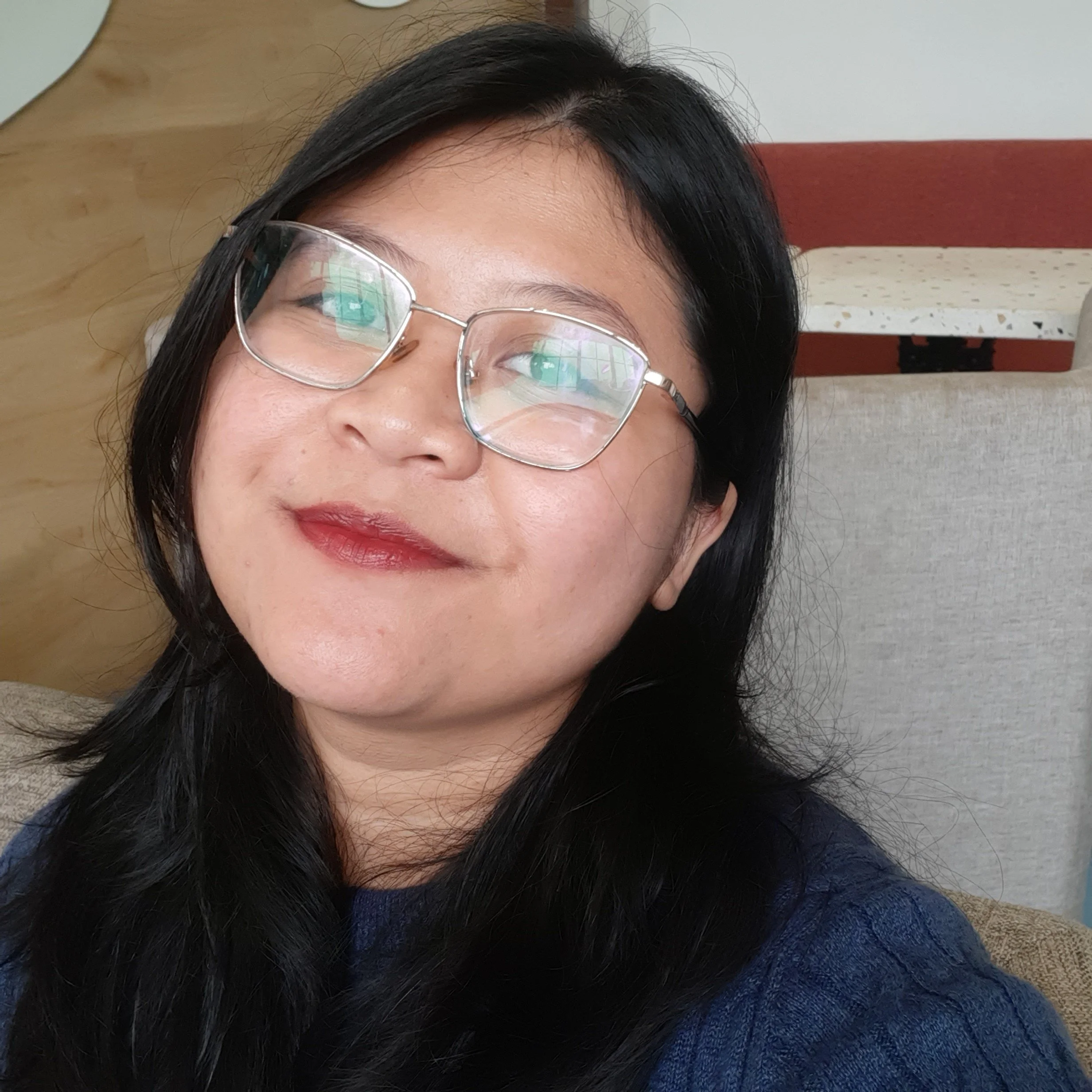
Alifya Maheswari (she/her) is a writer, feminist activist, and queer community organiser based in West Java, Indonesia. Her primary medium is the written word: short stories, poetry, plays, personal essays, and nonfiction articles. She has been writing since she was seven years old and has never stopped since.
She holds a degree in English Literature and has worked with feminist media platforms and nonprofits to write about gender, queerness, and social justice. Her creative works often revolve around the intricacies of emotion, identity, connection, and hope. They're also informed by the intersection of her identities as a neurodivergent queer woman from working class background, living in a primarily conservative and religious environment in Indonesia. You can find her on Instagram @alifya31.