
ILLUSTRATION: PAPERLILY STUDIO
The Pursuit of Happiness
Christopher Bryant
1.
I’d like to begin with some background.
At 16, I began my first toxic love affair: alcohol. I drank it quickly, often, and until I blacked out (which was often, and embarrassingly quickly). I drank this much because I really needed an escape – not that I knew it then – but the problem, of course, was that then I couldn’t stop drinking. It began once or twice a month, then once or twice a week, then just fucked up every single night.
Twelve years ago, In one of these states, I wandered onto a highway and was struck by the only car on the road. I flew up, and I fell down. I broke a lot of my body, cracked my skull, and injured my brain. I spent 12 months relearning how to: walk, talk, go to the bathroom, exist on my own terms, trust other people, and trust myself again. Then, I spent the following twelve years learning how to grapple with this trauma and shame, learning how to move past it and renavigate the world.
For many years before this event, I lived life with one foot lodged firmly in the closet. Every time I met someone new, I’d be on high alert: waiting, expecting them to slip up and reveal themselves to me as homophobic.
I remember being 25, in rehab, learning to live with a newly injured brain, and one of my friends winking to me, smiling: “live it up, babe! You can rely on this for at least fifty years, I reckon.”
I remember my father, that night, screaming at me for the idea I would ever be so goddamn selfish, because “other people have it worse.”
I remember this same friend squeezing my hand, his thumb circling my knuckles and his smile fading as he said: “well yeah, you’re disabled.” I remember the intense shame I felt as he said this, an assumed judgement of my worth: my art, my ability, my quality, my fuckability. This wasn’t his judgement: it was my own.
Around that time, I began identifying myself with a particular turn of phrase: ‘I’ve got a disability, but I’m not disabled. ’
For me, this was an important definition to make. It spoke to what had happened, but it wouldn’t let anyone mistake me as someone with true disadvantage. To me, ‘disabled’ was a negative word with negative connotations. Disability was something that happened to other people: people in far off places, in different countries. People who had earned it somehow, through some force of cosmic justice. People who weren’t me. I could never see ‘disabled’ for what it actually is, just a factual statement: my life is limited by the barriers set up by our society. If I had, I might have had to accept that life is more random than we’d like it to be. That you could just get hit by a car at any random point, and your life could be changed irrevocably.
2.
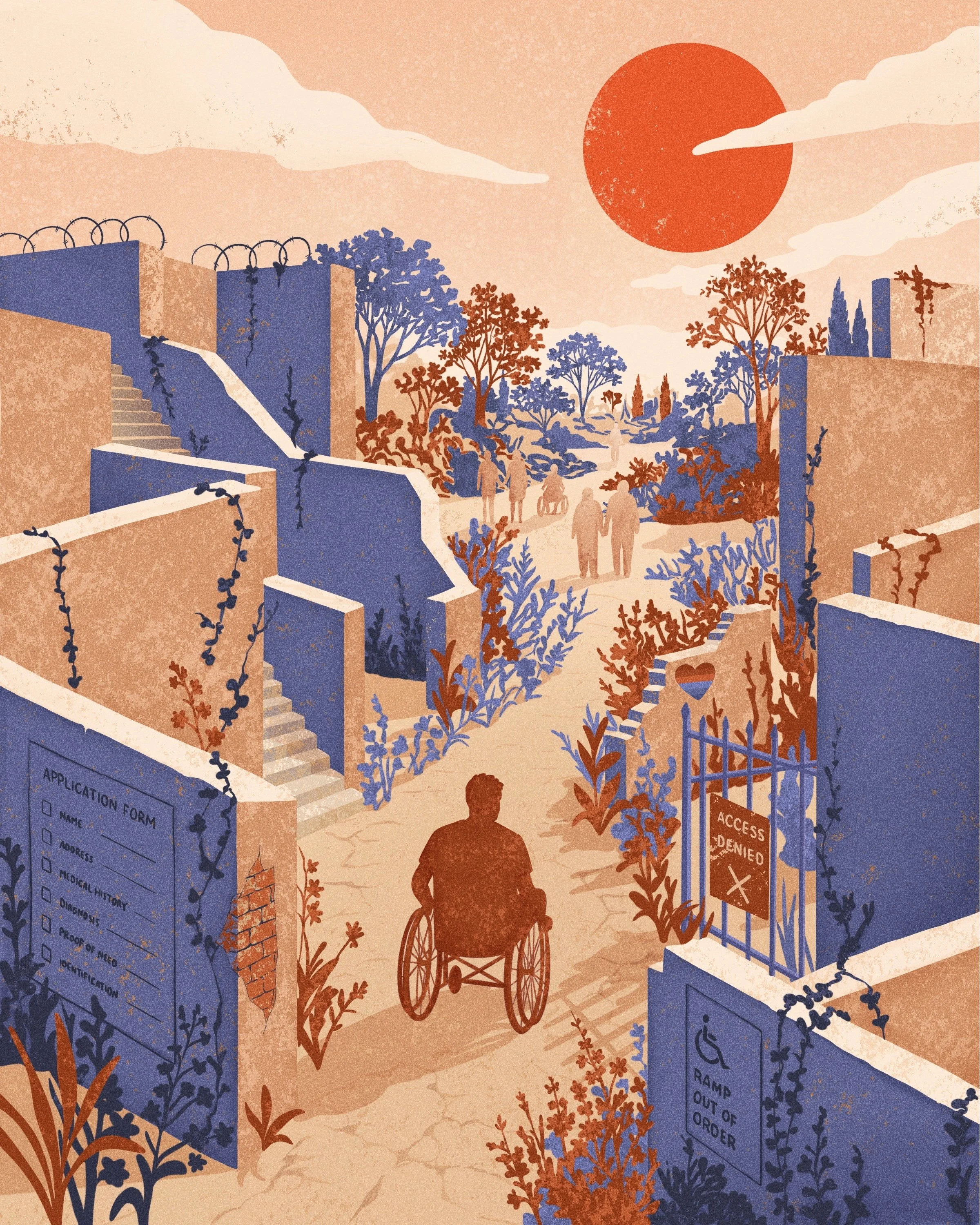
Being introduced to the social model of disability fundamentally altered my perception of disability, and therefore of myself. The social model states: disability, as an entity, does not exist. You are not disabled by your body, your brain, your senses. You are disabled by society. By the world around you that refuses to help lighten the load even one little bit.
A few years ago, now, I was at this very large, multi-level queer party thing. My relationship with these things is strained at best: the regular partygoers, those in the majority, move fluidly, easily shifting in and out of every experience with an ease that now is forever lost. I, meanwhile, am consistently and acutely made aware that these environments are not meant for me. I move in these self-conscious zigzags, always watching: I can go over here, but not over there. Here might be okay, until the crowd fills up and closes in, and over there might be...?
I remember dancing with some friends. Which is wild, because I don’t dance - not really a disability thing, more a ‘feeling okay in my body’ thing, which sounds like a disability thing but in reality is just how I’ve felt in my body ever since I was old enough to dance at silly parties.
I can see, across the way, one of my friends facing me - and someone else with their back to me, leaning in to my friend, saying something, I’m not sure what. However, this friend looks concerned. Uncomfortable. Truth told, I’d had a particularly strong pill about thirty minutes prior, was well on my way to peaking, and this apparently kicked in some greater motherly instinct I’d been repressing all my life until this exact moment. I know what to do, I think. I’ve been uncomfortable in situations like this before. I’ve needed an escape. I can do this.
I stride forward, the most confident I’ve ever felt at one of these things. I reach out. I grab my friend’s hand, grinning widely, manically, trying to psychically let him know: I’m here, babe. I can help. If you need.
There’s this moment of extreme tension that seems to last an age: me looking at my friend, my friend at this guy - and then, it breaks. My friend pushes past, waving away my concern, and sort of smiling: “oh, don’t worry, he’s blind.” I nod in acceptance and relief, follow him off through the melee. It’s only later that I realise: he hadn’t meant ‘blind drunk’, but ‘legally blind.’
There is a young man who cannot see in the middle of the dance floor at 2am, shaking hands with strangers and trying to introduce himself in the hopes he’ll find someone among the bodies and the noise and the sweat and the grime around him. A friend. A connection. A something.
It’s patronising, but even years later I feel an intense amount of guilt about this moment. I think it’s misplaced guilt, kind of. I couldn’t tell he was blind, but if I had, I feel like I would have done... something, I don’t know what. Shaken his hand. Introduced myself. What, fucked him?
I feel guilty because I understand. It’s the same thing when someone on Grindr or Scruff or whatever casually tells me that something is ‘retarded’. It’s the same thing when I meet somebody new and I have to come out again, and again, and again, managing expectations and my own internalised ableism. “I’m not just gay, I’m disabled - but, oh, don’t worry, I’m not like disabled disabled.”
I feel guilty because I know how difficult it is, particularly in this context. I know the downside to this community. This “queer not gay” group of muscled dudebros wearing ill-fitting op shop dresses while reserving body positivity entirely for Lizzo “community”. I know this, and I also know: I’m disabled. I’m queer. But I am also white. I’m cis. I’m middle-class. I’ve got a job; I go to the gym. I am easily afforded a part in this community, regardless of my feelings about it. And not a bit part: it’s a part where I can talk, I can write, and for the most part, people will listen.
I know this community: I am very often told it’s my community, and I take part in it because there’s not another one. But it needs to be chipped away from the inside, everyone acknowledging the shit we have all internalised and actively choosing to reject it. The heteronormative, abled worlds are so insistent on hurting our communities. It just does not make sense for us to hurt each other.
Some questions: how do you meet new people if not by fucking them first? How do you not feel ashamed when all you’re doing is seeing the world for what it actually is?
3.
The first time I engaged a sex worker, I was 32 years old. I was living in Melbourne, at the time. We had just come out of a year’s worth of punishing COVID lockdowns, and I had somehow received the largest tax return of my life. Momentarily flush with cash, I thought I’d pour it back into the local economy - after all, as our politicians kept reminding us: it was everyone’s responsibility, we had to work together.
My interest was almost scientific in nature. This was something I had long fantasised about: having someone whose sole responsibility was tending to my pleasure, and not having to feel bad about it because I’m paying him handsomely. (In my fantasy, I had completed the relevant checks and balances: sex work is real work, and I knew, somehow, this was ethical sex work).
The transactional nature also meant that I wouldn’t have to try and navigate a stranger’s housemates, I wouldn’t have to worry about him dropping the r-slur ‘just as a joke’, and I hopefully wouldn’t have the extremely awkward realisation I’d just spent a half hour enthusiastically deep- throating a Young Liberal. (There’s not enough Listerine in the world). Basically, I imagined this intimate exchange where I could play out my desire without any fear of rejection. Not rejection for my desire, but rejection for my disability.
I am not on the NDIS, although several people have told me I could be. In truth, I’ve avoided the NDIS as much as possible - which really seems to be what the Australian government wants. Like a lot of artists who don’t come from money, I’ve done my time contending with the intense bureaucracy of Australia’s social services. I’ve been told to get a real job, been asked why I decided to study theatre, and told to remove any reference to the arts from my resume. Like a lot of disabled Australians, I have also been told: “you’re not disabled enough for the disability pension, you might get better, we just don’t know! Are you sure you’re not faking it? Okay, how about you have a year on the dole just to be disabled, get that one out of your system, but sooner or later you’ve got to get over it, join the workforce, and pay some taxes so we can fund some wars.”
A few years ago, I did exactly that, and it became instantly clear: I should be on the NDIS. In casual work I became accomplished at masking for a few hours at a time. I told myself: “It’s not that bad... just so long as I chug two litres of energy drink for each hour of my shift, and centre myself before engaging with a customer to stop myself blowing up over a simple request, and have somewhere I can retreat to after each interaction is done so my brain can recharge, and...”
Working 8 hours a day, 5 days a week, my life became untenable. A day in an open plan office has the unfortunate effect of bleeding into all my time not in the office. A basic workday turned my mornings, nights, weekends, and days off into recover for work or else. I found my life entirely defined by employment like never before, with no energy for friends, lovers, creativity, or anything, really. I hated it, and for the first time, I hated my disability. Like, really hated it: the way it made my life, mental battery, and my ability to connect, small.
This is what the Australian government means when they say they want to focus on “improving job pathways for disabled Australians”. They don’t actually care about supporting us. They care about having good little workers, energy levels, brain fog, chronic pain be damned. What they want is the Good Disabled.
The Good Disabled actively contributes to society. The Good Disabled has nothing to say about anything. They never ask for help, pay for all their own appointments, and happily take out health insurance even though it’s prohibitively expensive, most insurers won’t cover much of what we need and we are told time and time again that Australia has universal healthcare. The Bad Disabled, meanwhile, is someone who knows their rights, doesn’t push themselves beyond their limits, and respects the reality of what it is to live with disability. The Bad Disabled might even write an essay.
The recent Royal Commission into the NDIS was found by disability representatives to be “deeply disappointing in scope”, because it “fails to respond to the scale of violence, abuse, neglect and exploitation of people with disability”. Of this report’s 222 recommendations - spanning 12 volumes, more than 5,000 pages - the Federal Government agreed to just 13 recommendations in full, while 117 were accepted in principle (whatever that means). Essentially, this report recommended urgent reforms across housing, education, health, employment, disability justice, and disability services on the whole in order to make Australia a more inclusive society. And the government said: gosh, that sounds like an awful lot of work, doesn’t it?
When we talk about this idea of mutual obligations, it’s always the obligations of the person receiving support, but never about the government's obligations to the people who actually elected them. What obligations does our government have to disabled Australians? What obligations do disabled Australians have to a government that undermines them, ignores their exploitation, and desperately pushes unwell people into dead-end jobs just for the sake of a pithy headline in a newspaper run by the Murdoch oligarchy? To be fair, it is difficult to fulfil obligations when you’re off buying solid gold watches and having sex worker orgies all on the government’s dime.
I am so tired. And if I’m tired, how does the rest of the disability community feel? In the five years since I engaged a sex worker, I’ve had sex with somewhere between 30 and 50 people. Some of it, great. Some of it, horrible. But what’s it like for someone who doesn’t have the ease and privilege of just returning to an app?
Humans are social creatures. We gain comfort and security from physical contact. Touch can influence our mood, our thought processes and our reactions. Touch is calming for people in distress. One study even suggested that human touch helps to fight off infections. It does all these amazing things and more, and our politicians said not for you lot it doesn’t.
For one whole afternoon, I felt totally at ease. His name was Amir. He was about six feet tall. He was broad, pleasantly muscular, and a great conversationalist. We touched each other everywhere, all over our bodies, and then we just lay in bed together. We talked about the world, art, music, writing. My experience of disability, and his experience of sex work. He kissed me passionately, regardless of whether it was purchased or actual passion - although a few months later he invited me to his house for a regular hookup, no payment needed. I’m sure the minister would’ve loved that. A shining example of what it means to be the Good Disabled: someone who doesn’t cost the public a single cent.
4.
In the 1990’s, queer studies icon Eve Sedgwick published an essay: Paranoid Reading and Reparative Reading, or, You’re So Paranoid, I Bet You Think This Essay is About You. In it, she writes about the ways that humans approach knowledge and understanding in times of uncertainty.
She begins by detailing the paranoid approach, which is so common that we forget there are any alternatives. The paranoid reader is obsessed with gathering information: tracing links, constellating signs, making the invisible visible. They believe if they’ve read every piece of depressing news, listened to every incomprehensible voice on offer, they’ll be rewarded with certainty. They’ll be able to understand what’s happening, any potential consequences, and how these consequences might be avoided. When certainty never arrives, the paranoid reader returns to consuming information, caught in a feedback loop of brutality. The end result of this isn’t clarity. It’s disengagement. Numbness. At the end of this essay, she details an inverse approach to understanding: Reparative Reading.
Reparative Reading tells us it is always better to pursue nourishment rather than identify poison. This doesn’t mean being naive to crises or ignoring oppressions. To read reparatively means to resist and in doing so, to produce a new reality - one driven by pleasure-seeking rather than pain- avoiding. It means creating work that bubbles with hope, generosity, possibility, and creative rage.
Our society tells us to place queerness as ‘other’, as something deviant. In all its inaccessibility, it also tells us to Other disability: something to be pitied, looked down upon. But a reparative reading of disability asks us to treat our bodies with curiosity instead of fear: curiosity about the way our bodies work, and about the way society can work best for our bodies.
The leading cause of disability is simply the ageing process, if we’re lucky to live long enough. What might our lives be like if society was developed with this unavoidable fact at its core? What might we need to remove the words ‘queerness’ and ‘disability’ from their loaded connotations and encourage people to see them as just another part of life? How might we find possibility and even freedom in the way our bodies continue to change?
I truly believe that the way forward will emerge from communal happiness and stability. Not them and us, the marginalised and the powerful, but us and us: all of us together, with all our strengths and weaknesses, supporting each other when the structures of the world will not. Maybe happiness means accepting the truth about the way the world works: because if we accept the truth, we can work to change it. We can create a better world. All of us. Together.
The process of happiness never truly ends, we just make choices, every single day. We become self-actualised in our pursuit of happiness: our pursuit of queer joy, disabled joy. Not the achievement, but the pursuit. We all have to keep chasing it. Joy is a noble way to live.
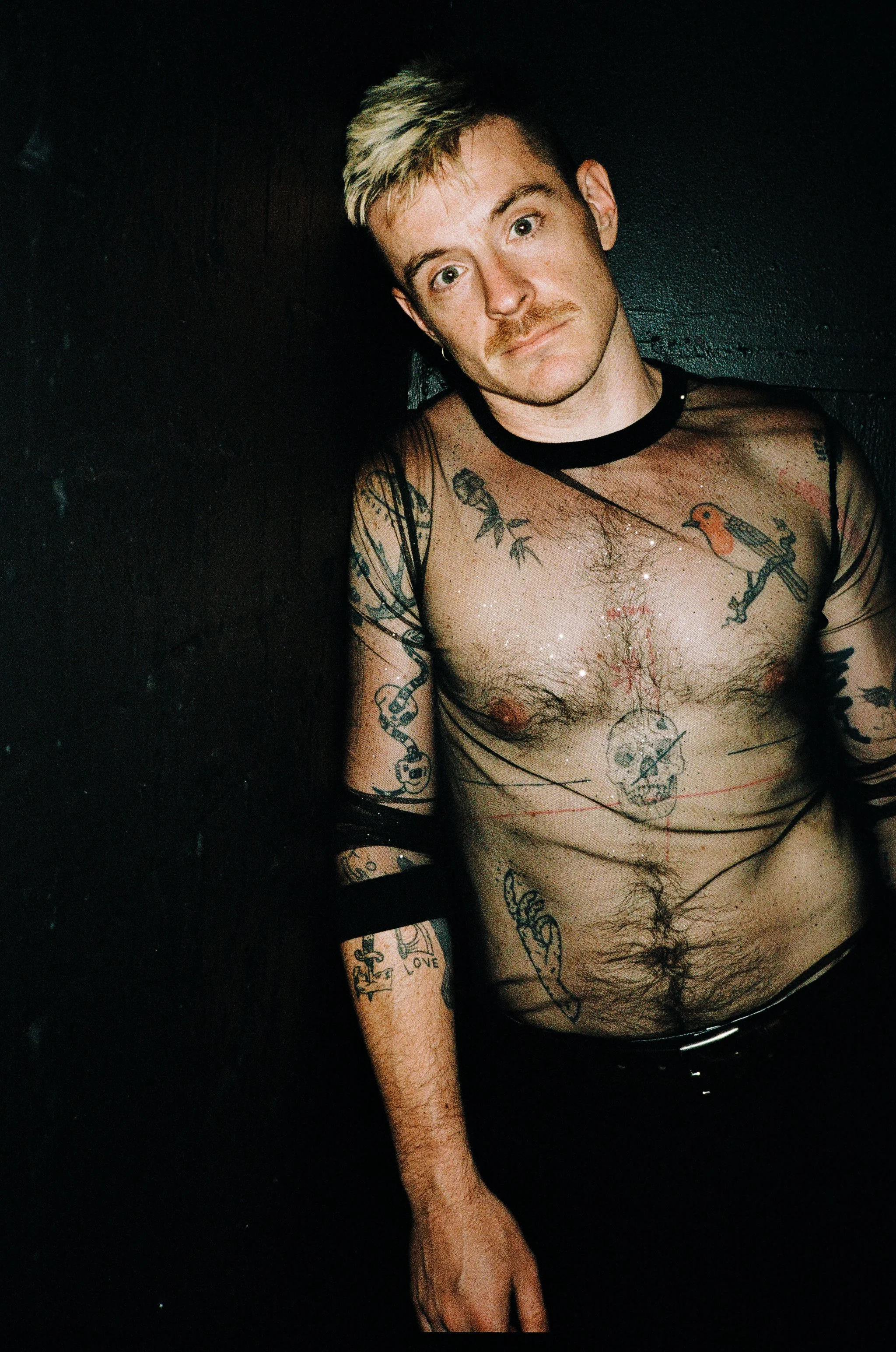
Dr Christopher Bryant is an award-winning playwright, performer, and author. He has worked with a range of companies including Griffin Theatre, Merrigong, Accessible Arts, fortyfivedownstairs, Malthouse Theatre, the State Library of Victoria, Wheeler Centre, ATYP, La Mama, and the Emerging Writer's Festival.
As an author he’s been published by Star Observer, Hello, Mr. Magazine, That Reminds Me, and Thought Catalog. He was also a finalist for Scribe’s Nonfiction Prize, Frankie Magazine’s “Good Stuff” Awards, and was the Writer-in-Residence at the Boyd Community Hub (2019). He has taught with tertiary institutions around the country, and completed his Ph.D. (2020) at Monash University, under the supervision of Jane Montgomery Griffiths.
Photo: Jasmin Simmons