
I owe everything to old lesbians
Em Readman
The first people I heard being homophobic were older women. Teachers, churchgoers, and extended family sat in chairs clustered around dusty glass outdoor settings. They would gossip, and I would listen. Rumours would swell under Queensland summer; if anyone knew the circumstances of so-and-so’s parents’ separation, that it was curious and odd that her mum moved out with the help of a very close friend. Speculation bloomed about what the length of someone’s hair meant. How was Allison and her roommate? Almost everything I heard about Queer people growing up was enveloped in scandal and shame.
At my school, no one was gay, or at least they knew better than to say it. After chapel, we would file out into the schoolyard wearing our paperbag dresses. Full of the good word, reminded to do to others as you would have them do, only for someone to call the girls who played AFL dykes. In a Study of Religion class, we were asked to stand along a line to show how much we agreed with certain statements. The exercise was supposed to show the diversity of people of the same faith. My teacher, an older woman, asked if we supported gay marriage.
I stood where I was, on the affirmative side. Another girl did, too. We watched as our classmates migrated to the other side of the room, stifled laughter spilling from their camp, and a welt formed in my throat for reasons I could not name. My teacher, slightly amused, continued the game; this statement was just one of many on her list. I genuinely believe she had never considered a Queer person might have been in her class, but, in an environment where even being an ally to the SBLGBTIQA+ community was an endangering move, her decision was not neutral. I could not name her betrayal without naming things I was not ready to say, and so I said nothing.
After graduation, I ran out of that town; I knew the gossiping would continue, but I didn’t need to hear it. It wasn’t until years later that I came out as bisexual, my homecoming to my nonbinary and lesbian identity still years away. Bisexuality was a lighthouse, a beacon, guiding me from who I was to who I would become. This is not everyone’s experience, but it is mine, and for it I am forever grateful. Without it, I would have washed up on the rocks long ago. In the end, through coming out, I gained more
than I lost. In a new city at seventeen, I surrounded myself with other young people, and we thought that we knew everything. I quieted the ring of the older women’s voices back home who pathologised and crucified difference. After university, almost on a whim, I followed the long road of the Nullabor from Yuggera and Turrbal Country to Whadjuk Noongar Country.
— —
I didn’t move to Perth thinking it would become a significant place for me. I just thought it was somewhere else. In my first few months, I spent a lot of time in my room. Then, I went to a Queer history tour at the museum. I went to my first Pride parade and stayed out until the sun came up. I met my girlfriend on a Sunday afternoon at a gin bar, and for our second date, we watched a lesbian version of Cyrano. When we walked down the street together, hand in hand, it felt revolutionary. It felt like we had changed the world together, and I was a world away from where I had started. A few months after that, I started visiting Western Australia’s Queer archive, in the belly of a University library. The WestPride Archive collection is split across a digital archive and a few walls of rolling shelving, dating back about ninety years. Down there, it’s quiet and cold. I walked down one of the aisles and flicked through copies of Forum and Lesbians on the Loose, shuffled through old photographs. I look at the lesbians in the photos, and then at the background. The shops have different names, but I know the streets they’re standing on in the photos, I recognise the undulation of the cityscape behind the subjects, and I know the beach they are posing at.
One photo, from the Perth Pride Parade in 1994, features a line of lesbians that look just like my friends and I. They’re all wearing t-shirts that read ‘DINK DYKES’, on a footpath that I walk down every day with my girlfriend. They are laughing; they’re funny and hot, and they know it. On one visit, I was holding a newspaper clipping, and one of the committee members pointed themselves out.
“I remember it well,” they said. “It’s always fun getting to stop traffic.” Being in that archive was the first time I felt connected to the past and to older Queer people who came before me. So much Queer history, particularly lesbian history, is lost to time and erasure, in equal measure. It was the first time I got to listen to older lesbians, hear their stories, and have conversations with them. It was the first time I truly
understood I was following a trail that was left for me to find, retracing their steps. The shame that I had carried from the older women in my hometown gossiping about lesbians dissipated after that first visit, replaced with a sense of pride and the knowledge that they had no idea what they were talking about. Being a lesbian was cool, and no one could tell me otherwise.
— —
One night, I was driving through the dusky Perth Hills to pick up Karin. We were having an event for the archives, and her collection and computer were on display. Karin started and maintained the LesPar Library, a collection of Feminist and Lesbian literature that she loaned out for free to the community in the 70s and 80s. She built a collection of 3000 hard-to-find books and magazines with her own money, and it was the largest collection of lesbian novels in Australia at the time. She had her own book organisation system and, as an IT career professional, had a meticulous register of her collection. She donated her collection, in its entirety, to the WestPride Archives. Karin is in her 80s now. She emerged from her home, cradled by towering gum trees, and we got started on the drive together.
We cobbled together a conversation, chatting about the exhibition and living in the Hills. At some point, she gestured to the state of the world and the resurgence of fascist politics, and I replied that I often daydream with my friends about packing it all up and joining a commune down south because sometimes, it seems impossible to overcome what we’re up against.
“What a completely ridiculous thing to say,” Karin responded flatly. I felt my mouth dry, embarrassed, as I tightened my grip on the wheel.
“The thing about communes,” she continued, “Is that they only ever get smaller.”
I listened intently.
“When I lived in Paris, there were areas, pockets of lesbians, and they would be happy for a while,” Karin said. “But over time, their circle tightened and tightened, and then they eventually collapsed.”
I remember being on the verge of tears, but fiercely motivated not to let them fall; I couldn’t let glassy eyes cause me to crash my car with a lesbian icon on board. I stole
a glance at Karin, her small frame in my passenger seat. She looked forward, focused on the vanishing point of the freeway ahead of us.
“But people were happy with that arrangement there, even though they never made things better, not even for themselves. The people I was around didn’t care about building something bigger. It’s part of why I migrated to Australia. I felt that I could change things in a bigger way than I could back there.”
“Well, I certainly think you’ve achieved that goal,” I told her.
“Maybe so.”
We took the exit and pulled into the carpark.
“You’ve changed my mind,” I say. “No communes.”
“You have a mandate to make the world safer for everyone like you, not just for you. You have to make the world the commune.”
“I understand,” I said, and I did.
— —
Jo, from the WestPride Archives, showed me pictures of the Cockburn Sound Women’s Peace Camp as she was preparing for an exhibition. In December of 1984, 400 women, a large number of them lesbians, camped and blockaded the entrance to the HMAS Stirling Naval Base in a multi-faceted anti-nuclear, anti-war protest. The signs from the protesters called for Aboriginal Land Rights to be respected and for military funding to be diverted to supporting the social and environmental needs of the nation. One picture has a lesbian being boosted over the fence, her wide-leg jeans flailing head over heels, as a line of moustachioed police stand bewildered. It’s a picture you can hear: the chanting, the rush of the water, the crackle of December heat, a beating drum.
Their protest brought national attention and scrutiny to Australia’s increasingly nuclearised relationship with the United States, the recklessness of defence spending and the rising toll of global, militarised violence. It’s something I think about often, as the current moment rises to rhyme with the conditions that caused that protest 40 years ago. Maybe it's hum never stopped ringing.
Lots of the pictures in the WestPride Archives are from protests. They serve as a reminder of how we have always had to gear up for the next fight, because there has always been another one coming, like waves cresting one after another over decades.
I read a novel by Dylin Hardcastle that introduced me to real-life activists, Claude Cahun and Marcel Moore. They were lovers and artists who embraced their gender fluidity and sexuality in 1940s France, and fervently resisted the Nazi occupation of their village through a secret, strategised pamphlet campaign. They protested their entire lives and laid everything on the line. They are remembered mostly for their gender-bending, surrealist, and whip-smart self-portraiture. They are also remembered as funny, with the story going that a well-timed joke during their trial saved Cahun and Moore from execution.
When I look at pictures from the archive, just as I look at pictures of Cahun and Moore, I am reminded of how much life was lived between the snapshots. Every person exposed on the negatives I look at campaigned fiercely to resist fascism, environmental destruction, colonial erasure, military power, and Queerphobia. They remind me that when Queer people fight for a better world, it can be a better world for all. Like Karin, they remind me that we have work to do, or rather, to continue. The final thing I notice from these pictures is that when people are not yelling, they are laughing. They are smiling. They are proof that the fight has moments of brightness. When I pick up their thread, I am holding a beam of light.
I take instruction from these photographs. They are what compelled me to start calling myself a lesbian and saying it loudly. In my early twenties, I held back on calling myself a lesbian because the term was so often publicly associated with trans-exclusionary politics. Now, I wholeheartedly debase the attempts of LGB-without-the-T coalitions and lesbian groups who make it their life’s mission to demonise trans women, and I’m taking my identity with me. Decades and decades of lesbians who have fought for a better life for themselves, their communities, and their planet do not deserve this mud on their name.
I look up to lesbians like Giz Watson, WA’s first lesbian parliamentarian, who fought against the felling of old-growth forests and helped bring forward the first rounds of SBLGBTIQA+ and abortion law reform. I look up to lesbians like Esther Montgomery, a Mardudhunera woman, who has tirelessly campaigned for intersectional First Nations and SBLGBTIQA+ inclusion, particularly in the health sector. I look up to lesbians like Jasper Laybutt, and his fellow G.O.D.s, a Queer vigilante group set up in Sydney in the
90s to protect people when a homophobic police force wouldn’t. I look up to lesbianism that is progressive instead of protectionist. I call myself a lesbian because I am living proof that older lesbians like these three, and thousands more, won their fight; I wouldn’t be here if they didn’t. Old lesbians make me want to become one of them.
— —
I attended a talk in a local library about the history of Queer protest in Perth. It was a full house. The speaker was animated and funny as he talked about the protests he was a part of. At one point, he was asked about how Perth had changed over the years. The room shifted as he lamented the closure of gay bars, saunas, and beats. You could tell how special those places were to him. He suggested that it was because, after decades of Queer rights campaigning, we could go anywhere.
“But people didn’t need them anymore, so we lost them. They were such fun. Maybe it was better the way it was, before we made all the fuss,” he suggested to the crowd, garnering scattered laughter.
An older lesbian sitting in front of me raised her hand. When she was called on, she stood to speak. Everyone turned to listen. I recognised her from the Pride Choir. “We fought for this. Don’t wish it away,” she said.
They went back and forth for a while, and the interview became a town hall. Another person chipped in.
“The closure of beats and gay bars was not our fault, anyway. The rents went up, that’s what closed them,” they said.
The room murmured in agreement.
“We wouldn’t even have dreamed of being in rooms like this back then,” another mused.
The attention turned back to the woman in front of me. She took some time to bring attention to the contribution lesbians made over the years that had gone unmentioned thus far, volunteering in the AIDs crisis, the Cockburn Sound Women’s Peace Camp in 1984, Pine Gap the year before, and the 1989 & 1990 Pride Protests, among others. She laid out plainly how far we have come and how much it took.
“We lost some spaces along the road, but we gained more than we lost, especially for the young people. We don’t appreciate how lucky we are to have what we
have. And we made that luck from nothing,” She concluded, then she sat down, leaving the moderator to scrape together a conclusion.
I was slack-jawed behind her, breath-taken. She had corrected the record so unfaulteringly, a silver-tongued oration of her story and the contributions she had made towards us reaching the world we were living in today. She acknowledged it was imperfect, that things were lost, but she focused back in on what was kept and gained. Her testimony reminded us how we live the impossible every day, but we cannot forget that it is never guaranteed. I mentally added her to the list of lesbians I look up to.
In the carpark, I watched her drive out and gave a nod, like she was passing me in a parade.
— —
Sometimes, we see a pair of older lesbians who live in our neighbourhood, walking laps of the lake counterclockwise. They walk arm in arm, gracing us with a knowing nod at our interlaced hands.
“I hope we’re like them one day,” I say.
‘Me too,” my girlfriend says.
“I hope my hair goes silver like theirs is,” I say.
“Me too.”
“I hope that when we’re old, people look at us the way we look at them,” I say. “Me too. Maybe they’re us from the future.”
“Maybe they are.”
In the WestPride Archives, there’s a collection of pins. Most of them are from protests. One is written in neat penmanship and simply reads, “There’s more where we came from.” I think that one is the strongest protest of all, the promise that there will always be someone else to pick up the fight and tell the stories. I owe everything to the old lesbians and all Queer people who picked it up and handed it down, and I intend to hold onto it long enough to hand it down once again.
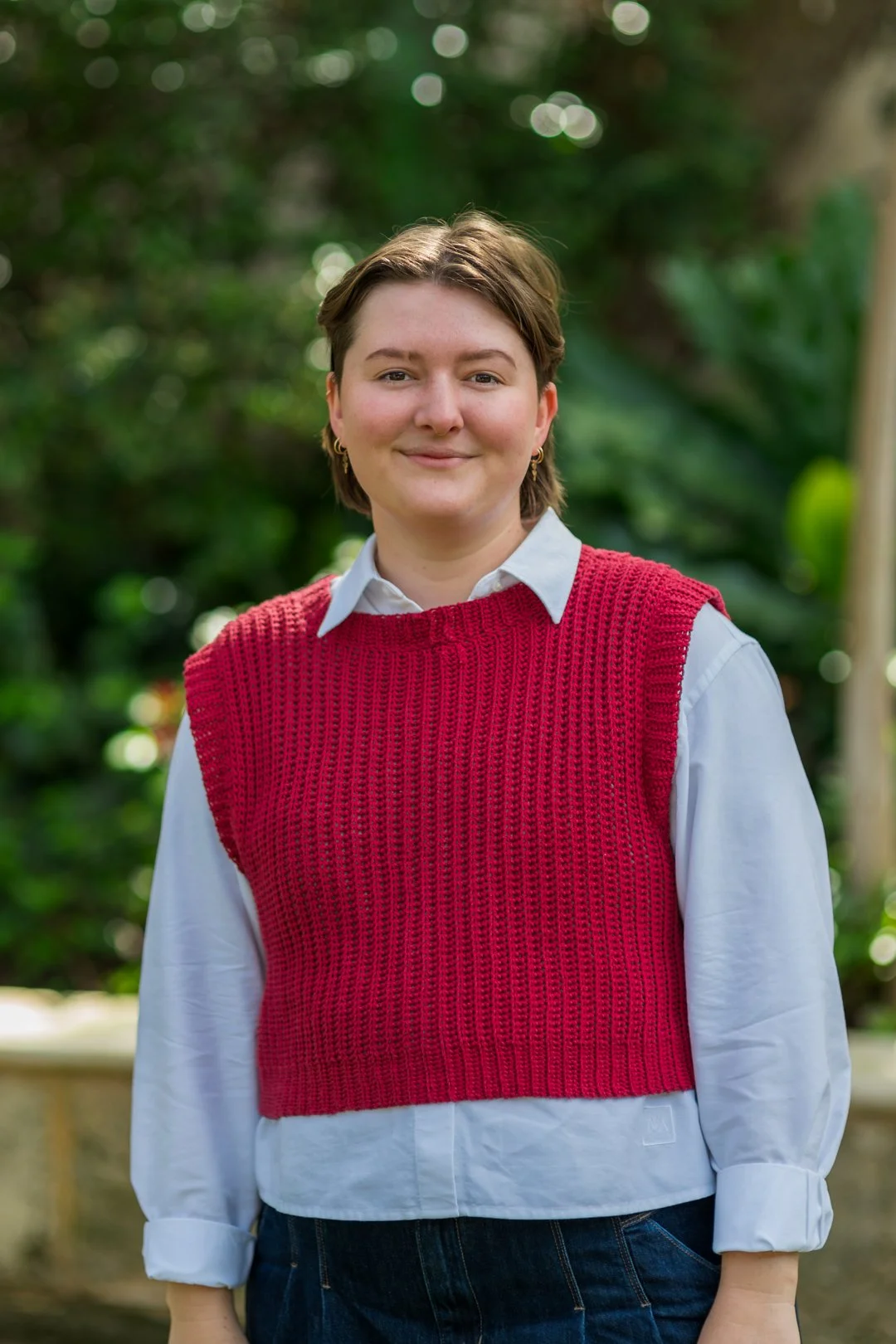
Em Readman (they/them) is a writer living on unceded Whadjuk Noongar Country. They have been published in Overland, Artery Zine, the Suburban Review, Voiceworks, and others. They are currently completing a Master's by Research at Murdoch University, focussed on queer life-writers experiences of publishing memoir, and are working on their first novel, Homemaker.