
Build a Bridge
Emma-Lee Maher
1
I feel hope crossing over the Fremantle Bridge on my commute to work. I’m a little heavy on the brake; the corners of my eyes crusted with sleep—fuel light on. Every morning over the last month, no matter the weather, a woman stands on the footpath holding a Vote Yes sign. She wears a wide brim hat that’s lost its shape and clasps a dented, red thermos. I wave, I beep—sometimes I pull a daggy thumbs up out of my rolled-down window.
Sometimes I cry.
2
A woman with a Vote No sign has materialised on the bridge. I shake my head theatrically, hoping she can see it through my dusty windscreen cracked straight down the middle. I need to call RAC. I’ve already pulled over once. Sometimes when I see her, I look away, which feels worse. I’m annoyed at her work ethic—coming out here in the final week.
By midweek, there are more of them. My steady Vote Yes lady is outnumbered. Swarmed. I’m annoyed at their work ethic, waiting for polling to open like the way some people wait for Black Friday sales. They crowd, and they make the most of it.
I finally crack and flip them off.
3
The day before the vote, we catch the Prospector to Kalgoorlie. I have memories of taking it as a kid with my Mum, of sleeping with my head in her lap. She grew up in Kal.
We eat fancy steak sandwiches I’d picked up from Mondo Butchers on my way to East Perth Station. They’ve lasted okay in my backpack. I watch the landscape flicker on the small TV, unfocused, the feed from a camera mounted on the front of the train. It’s like someone’s rubbed Vaso across the lens—soft around the edges like an early season of RuPaul's Drag Race.
4
After an okay night's sleep in the 1890s character cottage, we walk into town and quickly realise the elderly Airbnb host had said wide streets, not white streets. Whew.
Pioneering West Australian Paddy Hannan has been crudely beheaded. We peer through the modesty screen that’s been constructed around him. There’s a visitors' centre across from the crime scene; we go in and buy a fridge magnet. I turn it over in my hands—3D roos jerk their heads from left to right.
A man I dated in high school drives past, and both our necks snap to catch a blurred look at each other. Back then, he’d been sexting other girls—I only found out after he accidentally uploaded a photo of his dick to his public Snapchat story. I think he has a wife and kids now.
I find my artwork, Sweating, Shaking on Dingo Rock, in the cultural centre as well as a snaking line of people waiting to vote. Thongs, singlets. Sun-creased hands using pamphlets as flimsy fans. I pose for photos in front of my work, receiving recognition on the same weekend the nation votes on recognising us.
By early afternoon, the result is clear. Sitting at an Irish pub, my eyes welling up. Our phones are flipped face down on the sticky table ringed like a primordial tree. A guy who’d joined our table without invitation—drinking rum and cokes, talking about pingers—calls me a sook. We get into a bit; my boyfriend tells him to leave us alone.
My phone vibrates with a text from the Airbnb host. We saw the art prize, and your entry looks great.
I cried a lot that night. The pints didn’t help. I cried into my chicken schnitzel, the meal meeting my gut too late to offer any sobering effect. It was gross and embarrassing. I had to be held like a child. Through tears, I made sweeping declarations. I won’t make art, count me out of all those working groups, and don't email me for a yarn when NAIDOC or Reconciliation Week comes ‘round.
5
By daybreak, I’d softened.
I creep into the shared bathroom and press a cold, damp face towel to my swollen eyes.
The Airbnb host offers to hold our bags so we can go sightseeing, unburdened. I trail her into the big house. Put them here, love. I lean my A3 First Nations Art Award certificate against a faux roman pillar with a vase on top. The vase is filled with plastic Australian flags—glossy and stiff. I put our backpacks on a chaise lounge. A golliwog slumps against them, one button eye barely hanging on.
I’m all dried up from the pints and crying, my throat stripped—did I bum a cigarette last night? Our friend picks us up in his work ute, I’m a little embarrassed when we see him. The windows are rolled down, hot air tunnels through the cab—I can’t hear what they’re talking about up front. At the Super Pit lookout, I grip the chain wire while blowflies pile on me, greedy for any hint of moisture I’ve got left.
6
Crossing the bridge again, the footpath's empty. Just bumper to bumper traffic and the river below, moving as it’s always done—indifferent. At work, my desktop takes a while to boot. I’m stuck staring into my own reflection, eclipsed by a blue circle that spins and spins.
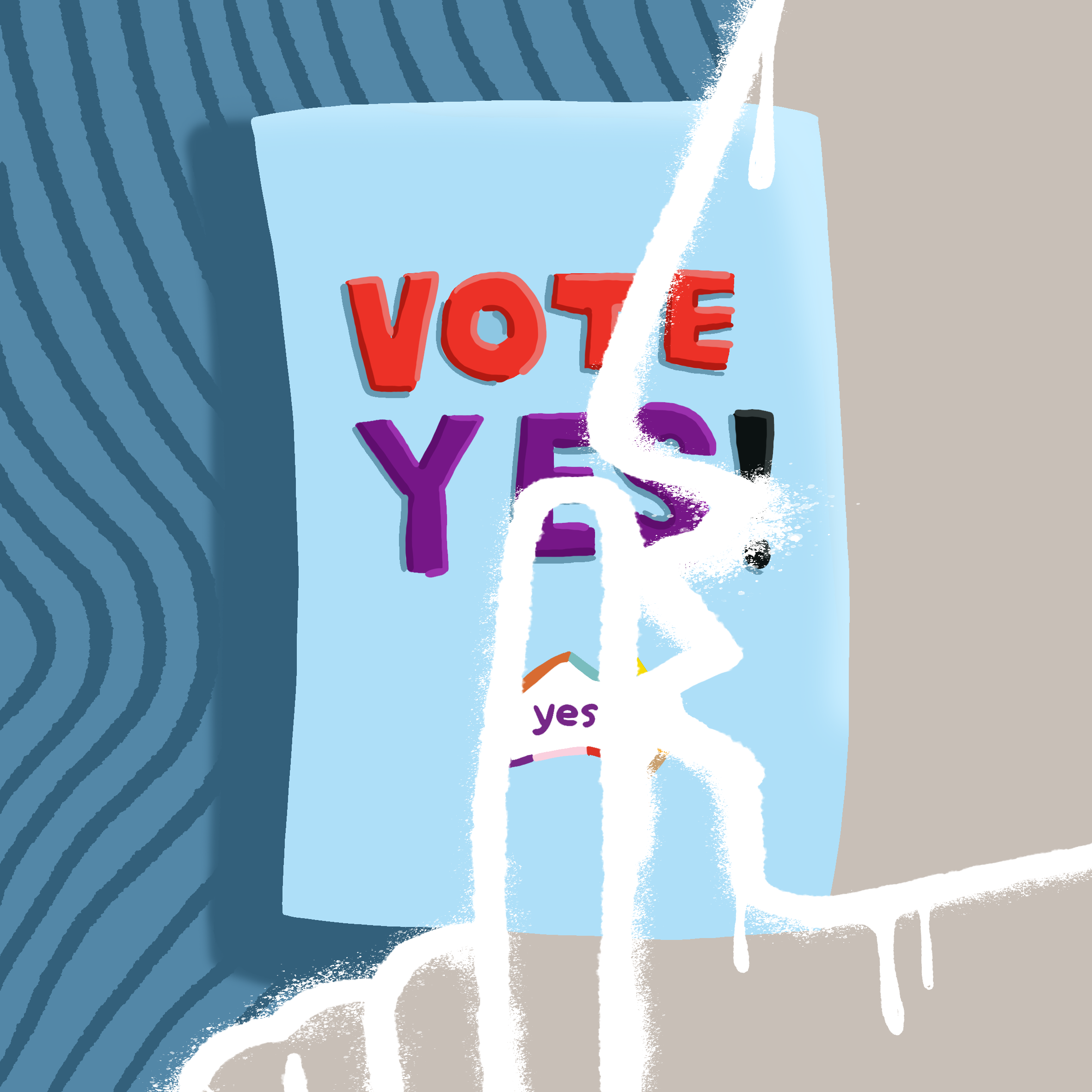
ILLUSTRATION: TYROWN WAIGANA
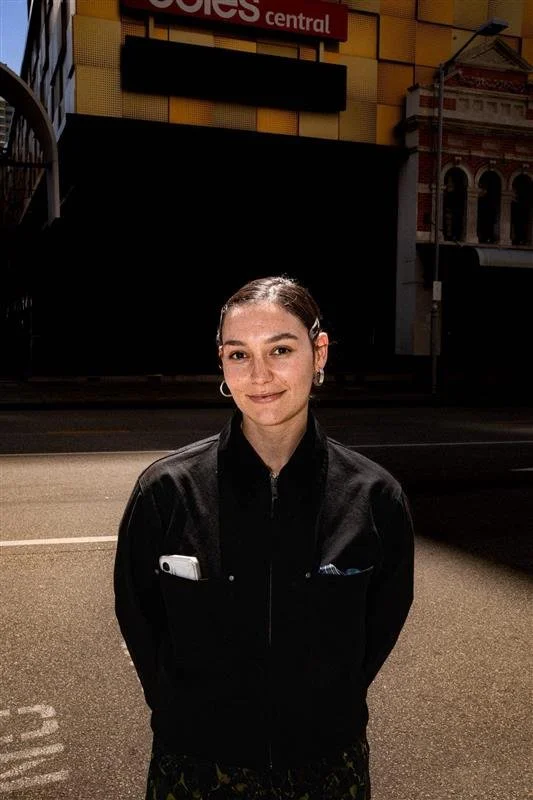
Emma-Lee Maher is a First Nations artist and writer, her work digs into memory, family, and place. Emma’s storytelling is layered, testing the boundaries between fact and fiction, self and collective memory.