
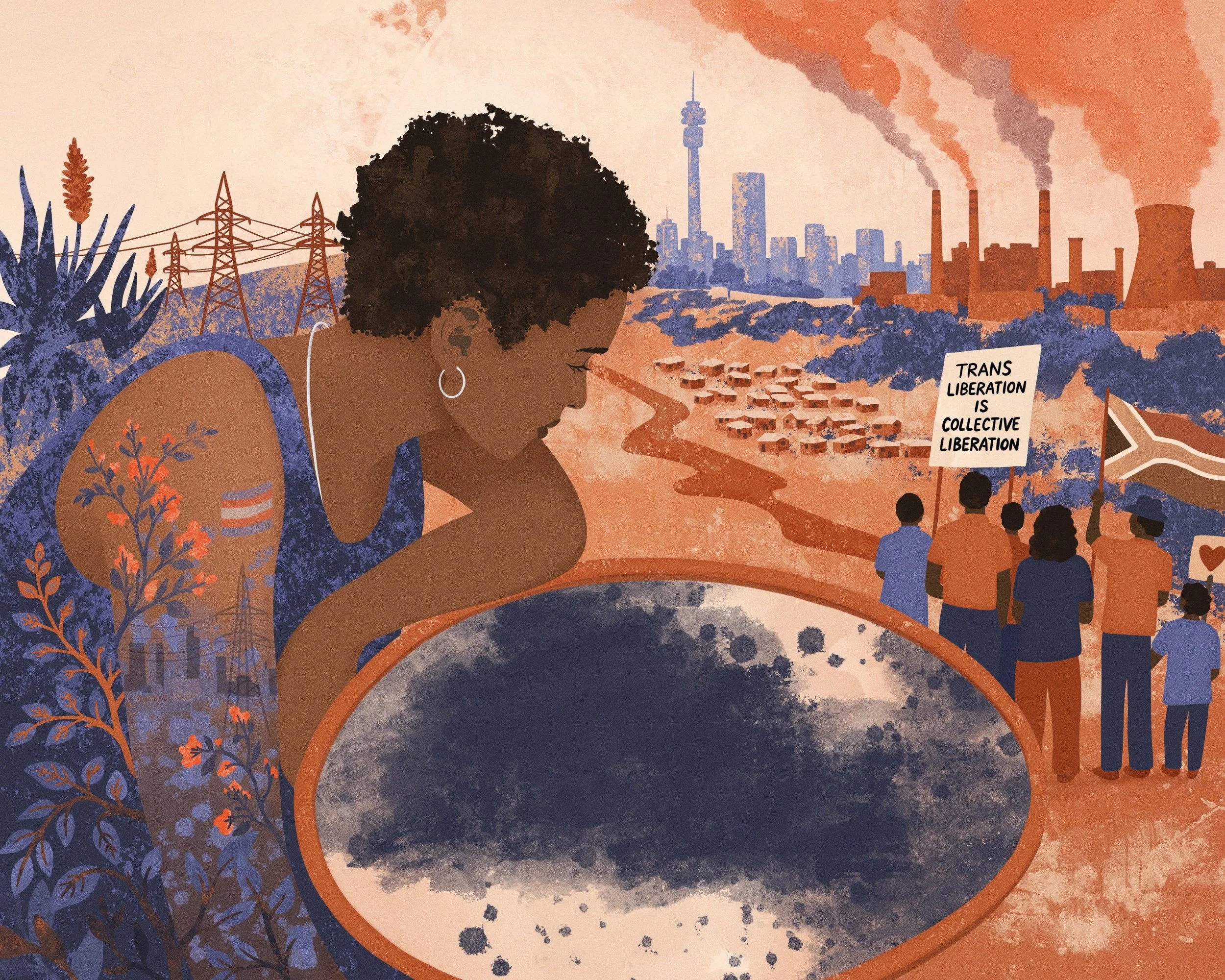
ILLUSTRATION: PAPERLILY STUDIO
Pollution stops the reflection
M Lombaard
I wake up with a sore throat. Johannesburg’s air is dirtier than usual: a combination of the dry winter, mine pollution, coal plants, other industrial production, and some small fires of people trying to keep warm. I contribute, of course, with my electric blanket, car, and I work in a corporate university now. I participate in polluting the air with coal-fired electricity; I am colonising the land and people in the Eastern Cape and Durban, and elsewhere, where oil companies are drilling and refining; I am participating in the world economy that prioritises profit over people. My throat burns, my sinuses are congested, and I have had two surgeries to improve my breathing. I use a water filter in the hopes that it removes some of the contaminants of the groundwater. I am lucky for all the medications and protections I can place around my body; I am implicated in the entire process of the pollution loop.
My body is trans, I take testosterone for masculinising effect. My body is trans, I breathe the pollutants that we collectively create. My body is trans, I eat and I drink and I take supplements. I take in, my body shifts, I let out. I have the right to gender-affirming care, and luckily I can afford some of it. I have the right to a clean and safe environment. Trans means across, to pass through; and I cross and pass in my very cells, we all do. Altered and unaltered are ideological concepts – I was born being altered, we all are constantly being altered. What we take in and what we let out of our bodies and minds are continuous processes of altering, of composing, and recomposing.
In 1996, South Africa recomposed with a new democratic Constitution, taught to me as the world’s most liberal and inclusive constitution. Yet, as oft repeated, people cannot eat the Constitution. South Africa is the most economically unequal country in the world, as measured by the Gini coefficient (World Population Review, 2026). We have what is known as a “transformative Constitution”: the law aims to create social change. There is a gap between the written order and the lived one. There is a space between what is declared and what is felt. There is a space that must be crossed, trans-formed.
If you look at South African cities from above, you can see the lines of racially designated living areas. In Joburg [1] there is the inner city with old Art Deco buildings, apartments filled with students and small families, the banking blocks that have been “cleaned up” with security people on every corner, and the artsy district where bars play jazz and tourists buy local artworks of giraffes. Around the inner city, are the suburbs with larger houses and gardens, high walls and fences, clusters of facebrick shopping centres and malls, and glass tower corporate offices. In Joburg specifically, the social and living spaces have become racially integrated, but, as in every other city in South Africa, there remains the single road heading out from the city to the “informal settlement” or township, where Black workers were to live to service the white city. There is a gap between the mixing of lives and those kept separate. There is a sustained system that holds the gap apart, that prevents the transing, the crossing of space. There is a solidification of a specific race and class nexus which keeps the line of inequality legible, in this peaceful democracy.
What do human rights mean? Do they exist to protect us? Are they a legal framework of recourse after injury? Are they a colonising ideology, used by nation-states like America and Israel to pinkwash or human rights wash their military violence, genocide, and war? Are rights a discourse which sometimes distracts us from material realities? Yet, comrades from other countries that are criminalised, or who do not have rights and protections, are suffering violations. Even in our very language I want to say their human rights are being contravened, but it is more their bodies, the relationships between humans, some basic care that is destroyed. Rights have become the first line of defence, the words we use to describe our dignity.
When I moved to Joburg five years ago, I felt like I had the space to figure out my queerness. I cut off my long blonde hair, I went home from a bar with a gay poet who rubbed my back while I had hiccups. I drank a bit too much, as it helped me relax and talk to strangers. I had hookups off apps with straightish men that asked me about my sexuality. Lesbians did the head nod in the grocery store, I was being recognised and it felt good. I was walking home with a girlfriend one night and someone shouted an Afrikaans slur at us. I was talking to a stranger who was trying to pick up my friend outside a bar one night, and he called me a slur in isiZulu. People stared at me in the streets, I moved to a neighbourhood with a younger population.
Through a series of meetings and friends of friends, I built up a queer community. One year, we went to three of the local Pride parades. Although they all take place around October and within 80km of each other, the differences between them are fascinating. Soweto Pride is where the activists and NGOs gather; the march is way more intense – and important – in an area where, infamously, homophobes and patriarchs murder and rape Black lesbians. Outside the venue, in a field, families braai [2] and party; and there is a significant international presence, with embassies and international organisations providing some of the funding. Pretoria Pride is whiter, as white gays organise the event in a mostly white suburb, and Pretoria tends to be more racially segregated in social spaces. Pretoria is also generally two degrees hotter and the march takes place on concrete roads around a sports stadium. A truck full of white bears [3] had set up a kiddies pool in the truck bed where they sat in their swim shorts with beers, splashing marchers with their bathwater. Joburg Pride has corporate branded rainbow cars, drinks, and merch; the march is through some of the richest areas of Joburg; and a few activists with pamphlets compete with companies selling merch.
Sometimes, politics play out on a small scale and become gossip. In 2024, I was shocked to see that a company on the Palestine BDS (Boycott, Divestment, and Sanctions) list [4] was sponsoring Joburg Pride. In 2025, some queer associates were talking about how disgusting it is that this funding, which also funds genocide, is routinely accepted by the organisers. We formed a group online to start a small protest. This was not the first time a protest of Joburg Pride had been held: Black feminists held a “die-in” in 2012 during the march to honour the murdered Black women and lesbians, with negative reactions from Pride attendees and organisers (Davis, 2012). In 2025, trying to set realistic expectations, we agreed that if only 10 people learned about BDS and maybe became more involved with Palestine and solidarity activism, then our protest would be a success.
A week later, we posted an open letter on a Queers for Palestine social media page, which was seen by 80,000 people. Suddenly, we were receiving media requests, had interest and people to organise, and were being defamed by one of the Joburg Pride organisers on her public Instagram account. Our campaign was against the corporatisation of Pride; against funding for Pride from companies on the BDS list; and the inaccessibility of Pride in the richest square mile of Joburg, with expensive vendors and limited transport options. I received a call from the same Pride organiser, shouting at me for accusing her of committing genocide. A few of us received badly spelled cease and desist letters from her lawyer. The (lesbian) deputy minister for Women, Youth and Persons with Disabilities became involved and organised an online meeting between all of the parties: the public queer infighting detracted from the cause of Pride, and she seemed to think this was embarrassing. The meeting did not resolve any issues as personal beef became the primary focus, and the issue of how to have a Pride that serves the LGBTQI+ community in Joburg became an add-on agenda item. One organiser said they were accepting funding from companies on the BDS list, and another quickly retracted this and said that it was under discussion. The Joburg Pride social media pages and website deleted any mentions of sponsors. My ex-partner wrote a take on the entire situation without being involved in or present for any of this, and it was published in a reputable newspaper.
In the end, that year’s Joburg Pride was split between two events: a public picnic in a park and the march in the rich suburb. Our group, dressed in black to symbolise the ideological divide from this Pride with queer (as in political) values, stopped the march on its route. We sang the usual free Palestine chants, along with struggle songs from apartheid that are still commonly used at protests across South Africa. All of the marchers within earshot joined in and stopped the march with us. The organisers claimed that they had made space for our protest, and their event continued. A public discussion had been held, once again, about how to perform Pride: whether politics or partying would remain central to the cause.
The problem with liberal democracy and a human rights framework that slots so neatly into capitalism, is that our individual lives become quite separate from worldwide power networks. Or, at least, we do not draw the connections. I can talk about transness, and someone else can talk about Blackness, and we can watch the genocides in Gaza; Sudan; Congo; and so forth (!) on our phones, and we can experience these as separate realities. Sometimes we buy into the ideology of separateness, sometimes we are living our own struggle without the space to draw the connections, and sometimes we are just so tired. When we are able to draw the connections, we can talk about how marginalisation means different things to us structurally but also talk about how some of our experiences overlap, or do not. Perhaps human rights discourse as the primary discourse around justice is the issue – either we have legal rights, or we don’t; and either we experience those rights in society, or we don’t. The world and our experiences have a lot more shades than that. The paper (or digital) acts and laws are not trans-lating, are not trans-forming. We are all interconnected but the ink on page and pixels on the screen are not interfacing with our bodies in the way that we conceptualise.
Our connections and disconnections are a lot more complicated than a legal framework or international standard can account for. Jasbir Puar (2017) points out that the language of disability doesn’t work in Palestine, because it forms part of a liberal democratic framework that feels universal in the neocolonial Americanised language of human rights, but many people are structurally excluded from access to these discourses and the bureaucratic and legal support networks that they link to. Some people are bombed by the very proponents of so-called human rights. Puar proposes the word debility instead of disability – Palestinians discuss their own maiming as in being debilitated; they are excluded from and decimated by the world in a structurally debilitating way.
Human rights do not fix structural issues, they do not facilitate community support. Human rights may be a tool amongst many, but the human rights language which dominates injustice discourse, does not account for many contexts and structural injustices. Constitutional abolitionists argue that the South African democratic Constitution, in fact, legalises the current unjust material reality by creating a goal of transformation that is not enacted or enforced materially (Modiri, 2019). The debility from colonialism and apartheid, perpetuated by capitalism, is not sufficiently addressed by this transformative Constitution. Law and capitalism have become institutions that legalise the extraction and dispossession of the world majority, of the global South, of black South Africans and Africans, of indentured labourers from India. Our struggles and discourses have to be connected because our oppressing structures are.
A few months ago, I went to India to visit a lover who cannot return to South Africa because immigrant bureaucracy and loopholes made them administratively stuck in their birth country. I went to a trans protest in Kolkata – the government of India is amending the Transgender Persons Act; trans people can no longer self identify but require medical confirmation of specific prescribed transgender identities (Varta, 2026). At the protest, I see more transfeminine people together than I have ever seen before. I did not ask how anyone identifies, of course, but some of these were older people who had been activists for years. They are demanding their human rights, or shall we say their dignity, as they should. A part of me broke that day. We are everywhere; we have always been around; and we have been fighting for social justice… law and rights have not solidified change for us.
South Africa does not have the same strong sociocultural genderqueer identities in as visible a way as India does, our trans elders are more hidden or have an entirely different story. We have a few transfigures, such as Kewpie who was a genderqueer hairdresser, performer, and activist (GALA, 2026). There is also a much darker side of transness from apartheid South Africa: some people with same-sex attraction were forcibly transitioned in their gender, so that they could “achieve” a heteronormative life (Swarr, 2012). This is an atrocity, of course, a way of asserting state power on the body to make it fit a mould. I wonder where these trans and cis elders went, I hope their bodies became theirs again, I hope their loves supported them. Our interconnections cross time and place and identity.
Rights can be given, and rights can be taken away. Bodies can receive support, and bodies can be damaged (actively and passively). State power, informed and structured by coloniality, can be viciously destructive to people. Rights can be a temporary structuring for some people as some protection, as some fallback, as some claim to humanity. But human rights certainly are not granted to all humans within a nation-state area. Human rights cannot be the only thing between us and the damage our states can do, human rights cannot be the only claim we have to being treated with dignity. I may have the right to clean air and water and an environment that supports my wellbeing, but our entire political system and economy does not allow for that right to be fulfilled. I may have the right to free healthcare and education, but the quality is often determined by my ability to pay for privatised services.
We fight for justice, for each other, for people we care about and are in solidarity with. Rights can be a strategy towards an end, but rights cannot be the goal. I do not fight for a colonially structured and corrupt state to say that I have protection as a citizen. I fight and work for my siblings in India who have been activists for dignity and respect, for all the people who are not citizens in my country and who struggle to make ends meet, for all the queers who lose their family support, for all the debilitated who are not allowed into many spaces in society, for the old and young who do not have freedom, for the parents who do not have support. I fight against capitalism and green colonialism that continues to extract from and exploit people in Africa for the benefit of the global North.
We are all transformed by the world. Our atoms carry the breath of plankton and trees; our eyes cry polluted seawater; my sweat smells acrid from the depo-testosterone; my phlegm is thick from the smoke in the air; my neighbour coughs and I catch a flu; my friend ate garlic last night and it stays on their breath; our water filtration systems remove dead rats and bugs; I wear glasses so I can see a stranger smiling at me. We are not fighting for our rights, we are fighting for each other.
Footnotes
[1] A commonly used abbreviated version of “Johannesburg”
[2] braai = barbeque
[3] bears = an archetype of hairy and stocky, generally bearded, gay men
[4] This list targets specific companies with ties to Israel, as a strategic way of putting economic pressure towards ending associations with Israel, with the goal of ending the genocide in Palestine (BDS Movement, 2024).
Sources
BDS Movement. 2024. Guide to BDS Boycott & Pressure Corporate Priority Targeting. Available: https://bdsmovement.net/Guide-to-BDS-Boycott (Last accessed 08/06/2026).
Davis, R. 2012. “Joburg Pride: A Tale of Two Cities”, in Daily Maverick. Available: https://www.dailymaverick.co.za/article/2012-10-09-joburg-pride-a-tale-of-two-cities/ (Last accessed 08/06/2026).
GALA (Gay and Lesbian Archive). 2026. The Kewpie Collection. Available: https://gala.co.za/projects-and-programmes/kewpie/ (Last accessed 08/06/2026).
Modiri, J. 2019. “Conquest and constitutionalism: first thoughts on an alternative jurisprudence”, in (Modiri, J.M. ed.) Conquest, constitutionalism and democratic contestations. Routledge.
Puar, J. 2017. The Right to Maim: Debility, Capacity, Disability. Duke University Press.
Swarr, A.L. 2012. Sex in Transition: Remaking Gender and Race in South Africa. SUNY Press.
Varta. 2026. Transgender communities reject Trans Bill 2026. Available: https://vartagensex.org/2026/03/14/transgender-communities-reject-trans-bill-2026/(Last accessed 08/06/2026).
World Population Review. 2026. Gini Coefficient by Country 2026. Available: https://worldpopulationreview.com/country-rankings/gini-coefficient-by-country (Last accessed 08/06/2026).
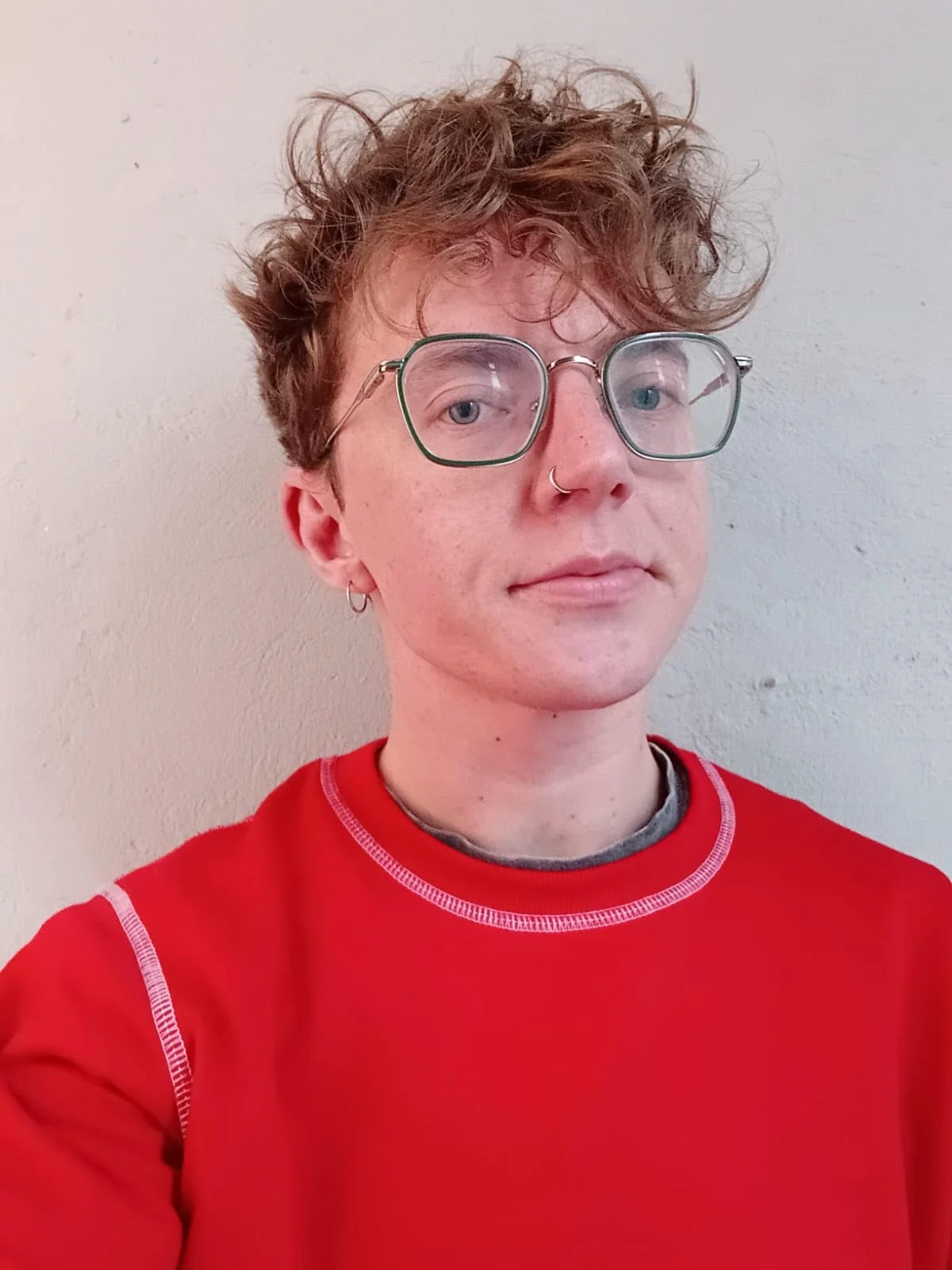
M Lombaard (they/them) is doing their PhD in Philosophy at the University of Johannesburg, focusing on climate justice. They care about activism and organise with Queers for Palestine in South Africa, focusing on solidarity between people and movements. They spend their time fighting (in a jiu-jitsu class), reading and writing, and having tea with their friends.