

The Collapse of the Rainbow: The State vs The People
Treyvone Moosa
A rainbow is a breathtaking piece of theatre: a trick of light and position.
To see one, the world needs to fracture perfectly, a storm behind you, and enough distance between yourself and the falling rain. The moment you walk into the rain, the mirage disappears. You are standing inside the very thing that, from a safe distance, looked like a miracle thrown across the sky.
In 1996, South Africa gave the world a gift. Our Constitution is lauded as an extraordinary legislative moment. Our new government had just dismantled apartheid’s racial segregation and was also refusing to uphold further systems of dehumanisation. The drafters of our nation's birth certificate knew that rights left unnamed are rights left undefended, so they wrote us all in—race, gender, sex, ethnic origin, sexual orientation and more—a positive obligation to substantive equality, free from all forms of violence, dignified justice, and state protection. For a people that had spent generations being erased by colonial law, by church and state and silence, being named in the founding document of our rainbow nation felt like an arrival.
I have come to understand The Constitution as a rainbow; from a distance it is breathtaking, but I am not at a safe distance. I am a black, non-binary, community organiser who has watched children expelled from their homes walk into this city and be renamed, reclaimed, and held. I have witnessed The Constitution in ways parliament has never managed to perform.
I have also watched us be killed.
— —
There were two red wine glasses, half-full, staining the table of our Johannesburg home.
Barney, a 39-year-old banker, who was deeply tender and complicated lived there. He was the kind of man who offered comfort, who kept his door open, and relished his desires, because The Constitution promised protection.
Barney loved me for 6 years. This is the first time I have found the breath to say his name out loud in 14 years.
But my deeper truth is even more fragile: I have never loved again.
On 9 September 2011, while we were on a break, the way two people take a break when they love each other and believe that they have time to regulate their emotions—apart. It was in that liminal space where a heavy downpour broke over my life.
Around 8:30. Monday morning. Our helper, Busi, arrives as usual.
The main gate. Wide open.
The car. Front door. Open.
Engine still running. Half-parked.
For any Joburg resident. An alarming scene.
Busi approaches the front door. Carefully.
“Hello. Hello. Hello.”
He is found lifeless and bound on the bedroom floor.
No signs of forced entry. Yes. He invited the threat in.
At the trial, a state witness, one of three men charged, turned on his co-accused and testified that one of Barney's killers had been in a secret relationship with him for months. Barney had wanted to help pay for the young man's university tuition. The plan, said the witness, was to overpower Barney while he was having sex with one of them. They wrapped duct tape around his face, struck him with a metal pipe, then looted the house and left him for dead.
I can’t really remember how I felt, exactly.
By now, I had lost so much, stripped of all innocence. Just stuffing grief into a mental drawer marked ‘unbearable/forget’.
What I remember clearly is this: at sentencing, the presiding judge, George Maluleke, said that an almost middle-aged man associating sexually with twenty-two-year-olds was playing—
“a dangerous game.”
The court had found its moral concern. It was not the murder; it was the desire that preceded it.
Section 10 guarantees inherent dignity, but here, the bench stripped it away. Judge Maluleke reframed Barney’s identity as his indictment, mutating The State’s obligation into an instrument of shame.
For years after, I treated his desire as a crime, too.
Barney was not the first and the public record agrees:
Jim Cathels, murdered in his Berea home. December 2010.
Oscar O’Hara, 33. June 2011.
Siphiwe Nhlapo, 36, Soweto; acid to his body. September 2011.
Then my Barney, 8 days later.
Then a 47-year-old unnamed landlord in Northcliff, 6 days later.
Then activist and television presenter Jason Wessenaar. Pretoria.
Then Rulov Senekal. Then—
2 more. Cape Town.
8 men. Gauteng.
The pattern was so legible it had grammar: in the many befores and afters. A media frenzy ensued. I avoided journalists like a disease, while within my own disease of grief. The Commission for Gender Equality called on the Department of Justice to ensure these murders were properly investigated.
The South African Police Service (SAPS) told the media there was no evidence of a serial killer.
The gay community, unconvinced, deleted their hook-up apps and shrouded their desires in shame. The criminals, also unconvinced, recognised a lucrative growth market and kept working. It was a rare moment of national consensus: both the victims and the predators completely agreed that the police had absolutely no idea what they were talking about.
It would be two years until Barney's killers were eventually sentenced to thirty years each. Two years that marked a period of total fracture and personal devastation. Section 7(2) mandates The State’s positive obligation to protect.
I learned something in that time which I have carried into every room I have entered since: The State will document our deaths before it will defend our lives. It will write our names in the book of the dead before it writes them into policy, into training, into budgets, into the lived reality of protection. The Constitution, a wondrous rainbow, was not a promise made to us; it was a monument erected for worldview: a mirage.
— —
Ten years later, I am sitting in front of an eNCA Checkpoint camera doing the same work The State had refused to do: naming a pattern. I had spent weeks negotiating ransoms quietly, invisibly, during the sudden kidnappings of some close friends. Men who had arranged to meet someone on Grindr and found themselves instead stripped, bound, beaten, and forced to call their loved ones for up to R30,000.
Going on camera was a different kind of decision. Visibility is a tool I have learned to use carefully, because it cuts both ways.
The syndicates were exploiting something The State had built for them: the certainty that a gay man, humiliated and robbed, would look at a South African police station and see not shelter but yet another violation. Section 12 guarantees safety from all violence, public or private.
A 2023 Human Rights Report on South Africa notes, "Civil society alleged that many Grindr cases remained unreported and undercounted because victims feared being outed.” The syndicates knew: shame is an excellent security system for criminals operating inside a community The State had abandoned.
18 months later - in September 2023 - SAPS arrested 7 men linked to the kidnapping of an 18-year-old Wits University student and connected them to 86 similar crimes across Johannesburg. The gap between the Checkpoint expose and those arrests is not a bureaucratic anomaly: it is a precise and damning measurement of how The State values our lives.
What I recognised in 2022 was what I had first understood in 2011: desire was being weaponised.
The argument’s scaffolding has always been State-built. The shame is State-maintained. We have learnt rather quickly to build shelters in the absence of State-protection.
— —
From the outside, The Equality Clause looks like a finished monument. No court has ever struck it down or formally amended it. Section 9 demands substantive equality, not just the absence of discriminatory laws, but the actual, material transformation of lived realities.
That is our own blind side: The State tilts its face toward a pristine document and mistakes the formal naming of rights for the substantive protection it never delivers. It does not need to formally rewrite the document to strip away one’s rights; it just lets the distance between the two become an ungoverned space. Institutional neglect casts a long shadow where violent predators have simply learned to hunt.
The Prevention and Combating of Hate Crimes and Hate Speech Act, the law that could change how these murders are classified and prosecuted was introduced to Parliament in 2016.
It sat.
Then lapsed.
It was revived.
It stalled again.
After 8 years of careful consideration, it was finally signed into law by President Cyril Ramaphosa on 9 May 2024.
We welcomed the law, we whispered, ‘thank you.’
South Africans are experts at a special kind of gratitude. We rejoice when the water runs, celebrate when the electricity stays on, and thank the municipality for the warning signs erected for swimming-pool-sized potholes on our roads. We have been trained to receive basic state function as a generosity: that when The State finally decided our lives were worth a piece of legislation, we received it mute with grief.
Some of us were still being buried when we quietly said, ‘thank you.’
Let’s be clear: gay men are not the monolithic face of the failure of state protection.
Two years before my loss, Eudy Simelane was one of the first openly lesbian women in Kwa Thema, a star of South Africa's national women's football team, Banyana Banyana.
She was gang-raped and stabbed 25 times. Her body was found in a park in April 2009.
When her killers were convicted - the first men in South African legal history to be found guilty of ‘corrective rape’ - the prosecutor was ordered to find an alternative word to frame the victim.
The word the court struggled to recognise was: lesbian.
At sentencing, the presiding Judge Mavundla stated: “In my view, Simelane’s sexual orientation is of no significance.” Her killers laughed.
According to ActionAid research, an average of 10 Black lesbians were raped per week in an explicit attempt to ‘correct’ their sexuality. It goes on to show that of the 31 murders linked to the practice of corrective rape, from 1998 to 2009, only one had ever resulted in a conviction.
One.
The record is long and it is consistent but 2024 was a blood bath.
Along the Indian coastline of Nelson Mandela Bay, five queer people are murdered in a single month; stabbed, shot, and found in their homes. Karabelo Pudumo, 18, a Grade 10 learner, was stabbed more than 20 times in Kimberley during Pride Month of 2024 by a man who realised she was transgender while she was simply out with friends. Jo-Ann Isaks, another transgender woman, was stabbed and burnt in the Northern Cape just a few weeks earlier, in May 2024. In Johannesburg, Clement Hadebe, 22, a transgender woman, never makes it home after a night of fun.
Section 1: is the founding provision of the supremacy of The Constitution and the achievement of equality, nobody is above it. Yet, protection only upheld on paper can be made desolate in the public domain in the voice of the right man.
In the same month Ramaphosa signed the Hate Crimes Act, former President Jacob Zuma publicly declared: ‘‘Who made the law that a man can date another man? Who will women be left with?’’
Five more queer bodies were found dead that month.
As of January 2026, the Department of Justice has only published draft regulations explaining how police should record hate crimes, not to prevent them, or prosecute them. Just record them.
The State has decided that what we, the People, need most urgently is better regulation on filing paperwork.
— —
We have been counting the bodies since 1998.
On 13 June 2020, during Pride Month, Kirvan Fortuin (28) was stabbed to death in Macassar, Cape Town. Kirvan had founded the House of Le Cap in 2017, South Africa's first ballroom house. He had hosted Africa's first Vogue Festival on World AIDS Day, using the ball as a public health intervention: a way to reach queer and gender-nonconforming people who would not walk into a clinic but would walk onto a club stage.
When news of his death reached me, I was asked for a tribute. I said: “I remember them as a fierce activist with a wild passion for our community. An engineer of the underground ball culture and Mother of House Le Cap.”
I chose the word engineer deliberately. Kirvan was not performing, he was not creating community for an audience or as an act of self-expression. He was constructing it with the rigour and intentionality of someone who understood that the structure had to hold weight, that people's lives would rest on it, that beauty and utility were not opposites but the same demand made from different directions.
On 31 December 2019, to a large audience of over 3000 at Afropunk, 40 queer Africans took to the stage and showed Africa how collective Pride moves at 126bpm. Our joy on that stage was a riot: loud, sweaty, and beautifully disruptive. We took up space in ways The Constitution promised we could. Kirvan never made it. He never got to see what he had already started.
After the lockdown of COVID-19, the Legacy Ball was constructed as a direct response to Kirvan's life. A love letter, Rori Bingham called it, a rebirth. By 2026, the scene has grown from a single-house event into a multi-house gathering drawing participants from across the country. Kiki houses proliferated. Ballroom expanded.
Not despite loss, but through it. Engineering community as its structural core.
A radical act of care.
— —
We are engineers: we do not rebuild despite our losses; we build from them.
Further along the Indian Ocean, near Mombasa, my good friend, Father Andeti, opens a ball with an arresting chant. The audience cheers. Outside, the Kenyan government is considering legislation that would imprison him for 30 years.
He opens the floor anyway, using his body, the only declaration left to him when every other has been legislated away.
Here, inside East Africa’s first ballroom lineage, in the House of Andeti, every strut is a felony, every category a beautiful, law-breaking riot of queer engineering. They manufacture a sanctuary, claiming unauthorised freedom beneath the threatening shadow of A Homophobic State.
In Nigeria, the Same Sex Marriage (Prohibition) Act which criminalises even the public display of homosexual desire, has left me exiled from West Africa’s vibrancy since 2019.
Lagos is such a contradictory place—look at the memory of Fola Francis, the woman who defiantly made history on the Lagos Fashion Week runway as a transgender model. When she later drowned at sea the city’s ‘criminalised’ LGBTQ+ community refused to let her light vanish. In June 2024, the Fola Francis Ball stormed Lagos in her honour and spirit. This was not just any event; it became a resurrection in joyful defiance, as ball participants trusted a photographer to document them knowing the legal risk, choosing to be seen, still. That trust between the outlawed body and the witnessing lens is itself a form of Engineering too. It says: we exist, and we want the record to reflect it, even if the record is dangerous.
An ocean away, a song from Kashmir breaks through a storm,
A rhythmic plea for solidarity
lodges itself
in my chest, a fracture
—a splinter of a shared sky.
We will not answer her with pity, but defiant plans.
We will build shelter with sticks of joy and bricks of belonging.
We call back a prayer for survival even if a home
betrays its colourful promise through cold neglect.
We call back a prayer for survival even when a home
weaponises the law to threaten our existence
—with a 30 year sentence,
the People offer a reflection:
We, the People, will engineer the counter-weight of survival.
Let us trace colourful lines of pride
so wide—across ocean tides
that no border can contain.
From the hushed, outlawed rooms of Lagos and the Indian Ocean coastline of Mombasa to the pulsating floors of Johannesburg and Durban, we can affirm: where The State vacates, the community builds as a deliberate act of political imagination.
In Johannesburg, Ballroom has remade itself as a workaround for excavating joy inside the ruins of The State’s abandoned promises.
When the heavy Vogue x Gqom bass drops, the walls of institutional neglect shake loose.
I am Mother of the House of Diamonds; a house, like many others before me, functions as a welfare system, a mental health network, and a chosen family structure for young people whose biological families have closed the door. It's in these found family structures where we are seen and celebrated, on their own terms.
And then we walk.
I love the tradition of the Grand March: where each house enters as a family, the Mother leads, the children follow.
They have spent weeks preparing: the looks, the categories, the formations. They walk no longer as strangers but as found family. They walk in joyful defiance of something the world tried to prevent them from becoming: whole.
— —
Whenever we walk I think of Barney.
I think of the two wine glasses. I think of the indefinite pause. I think about the stolen years. I think about the judge's phrase “dangerous game”.
The energy of these dancefloors is a radical, beautiful declaration. It is the insistence that we are allowed to be wild, safe, and incandescently alive, completely untethered from the shame the world tries to hand us. We don’t owe anyone our survival, but we demand it for the people behind us, the ones who haven't found the floor yet. They deserve to walk into a room that was made for them.
The Constitution wrote us in. We are so grateful for the naming. We are also very clear that naming is not the same as shelter.
The rainbow has collapsed.
We have been learning, for 30 years now, that real ‘Pride’ is not a celebration of law, but the active communal defiance of surviving whole inside a systemic storm.
Barney deserved to grow old, with me.
Kirvan deserved to see his house become a movement.
Eudy deserved a judge who could hold her dignity, fully.
Karabelo deserved to walk home from a night out with her friends.
The State offered us a monument of legislative paper.
The People must, in turn, offer each other a living, breathing sanctuary.

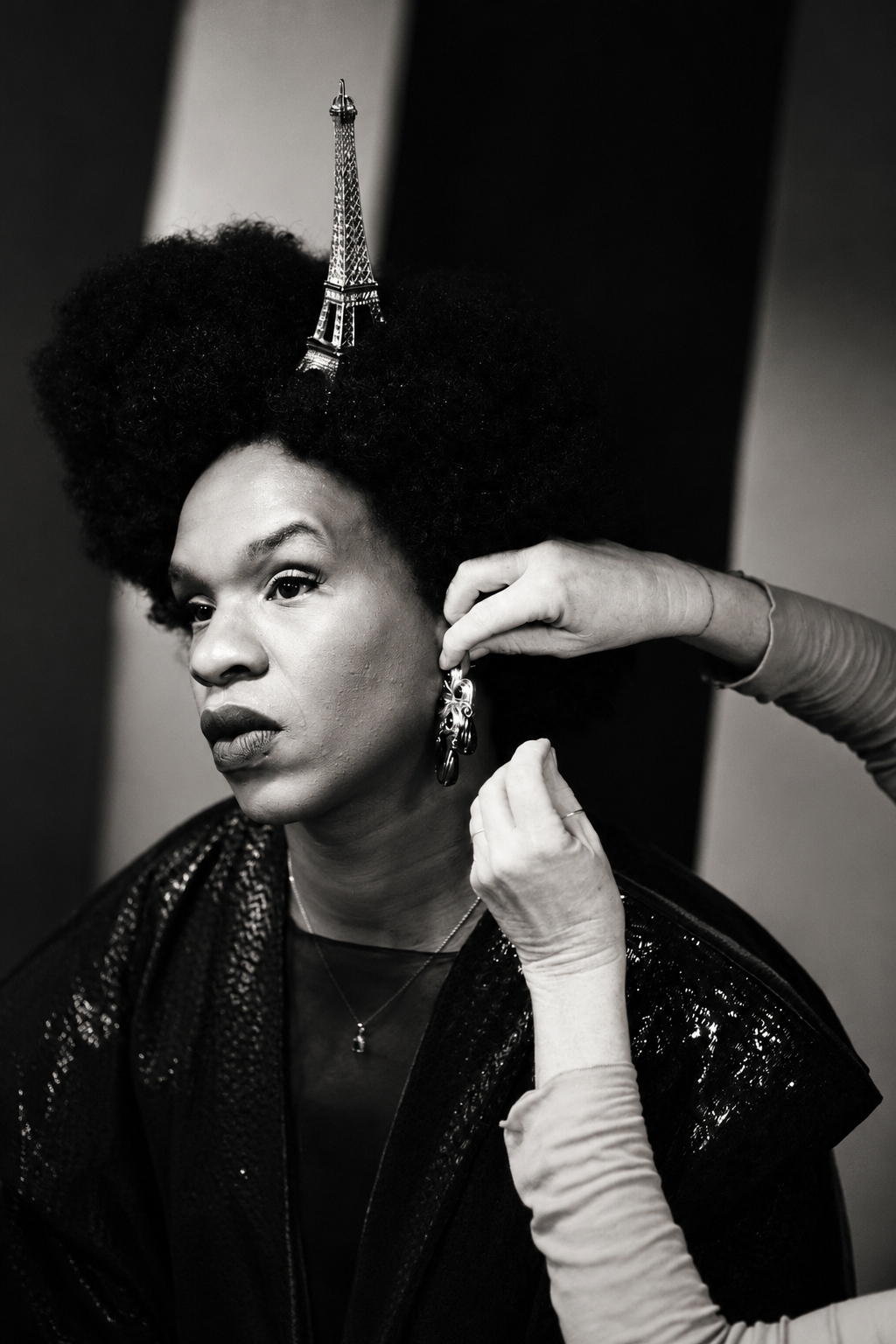
Treyvone Moosa is a Johannesburg-based strategist and writer whose work explores the intersections of identity, memory, power, and belonging. Their multidisciplinary creative practice spans poetry, criticism and live performance and cultural production. Treyvone previously served as editor of Exit, South Africa’s oldest LGBTQ newspaper. They write about Black and queer life, ritual and contemporary Africa. In queer culture, they serve as Mother of the trailblazing House of Diamonds, one of the pioneering forces in South Africa’s ballroom scene. Treyvone is currently completing Ritual For(me)s, their first poetry collection.